Friday, November 7, 2014

Germany, This Is Not

Everyone says that Belgium has three distinct personalities. There is the bureaucratic driven Brussels, the sophisticated, Flemish speaking Flanders, then the French speaking Wallonia. I live in Wallonia which is the poorest of the three regions. By all accounts life in this part of Belgium is slower and much more rural than the northern part of the country. The area is filled with historic hamlets and even the cities are small but most standards. Here you are more apt to encounter tractors than you are cars on some roads and I swear that cows outnumber people. French is the language of the region and it is quite possible to spend an entire day without meeting anyone who speaks English. It is also the poorest part of the country and this is evident when you drive on many of the roads. (Of course we spent close to three years living in Albania so it really is all relative). But do you know what? I really like it here.

For us, one of the best parts about being stationed in Europe is our ability to travel. When we lived in Albania we left the country whenever we could. There, travel outside of Albania's borders was a life line. It kept us sane, reminded us about everything Europe had to offer and provided a much needed respite from the day to day hassles. Since we've been in Belgium we've still been on the go but our travels are more apt to be inside of the country rather than out. We've been exploring every nook and cranny of our new home and loving it. But sometimes, it is still good to get farther away.

We spent last week in Germany which is so close, yet in many respects so far, from our home in Belgium. As we drove across the country to Berlin and back again I took in their perfectly paved Autobahn (or the portions that were less than perfect but actively being surfaced). Belgian roads are good in some parts of the country (Flanders) and a slow work in progress in others (Wallonia). Everything seemed so neat and orderly in the cities themselves and there was clearly a buzz that you just can't find in my little corner of the world. There was an efficiency about everything; streets and attractions were labeled, while not overly warm customer service was efficient instead of the typical pursing of the lips and "raspberrying" which is common in Belgium. And when we stood on a U-Bahn platform contemplating which direction we needed to go we were approached asking if we needed assistance. And most of all, everyone we met spoke English (not that this is an important criteria for us but it certainly does make things easier). Menus, signage and conversations were all bi-lingual (if not more). It was all really nice.

And now we are back in Belgium. Things are different here and I'm noticing it more than ever before. When fellow military members find out they are being stationed in Belgium they assume they are prepared because "they were in Germany before". This really isn't the case. It is hard to quantify the differences but things are slower, less organized and simply different here. Everything takes twice as long as it should. But the best advice I was given, and what I tell people who ask, is to accept it for what it is and enjoy it. I know we are. We really do like it here; if fact we just might love it. But then again it is all relative and we are just so glad that we aren't in Albania any more.

Thursday, November 6, 2014

A Reflection Of You & Me

Tuesday's election in US wrapped up what has become ever increasingly ugly campaign seasons.  Living overseas I was fortunate enough to miss all of the phone calls (the Vonage line had been temporarily disconnected for this very reason), campaign ads, unsolicited mailings and even doorstep visits by campaign workers eager to see their candidate get elected. I heard about it though. And with the fierce stalemate that has been the status quo in DC recently, combined with millions of dollars spent on a mid-term election, I can only imagine how truly painful it must have been regardless of which side of the aisle or color you stand behind. And now the people have spoken by way of their votes and that is really what living in a democratic society is all about. Right????

This recent election has the Republican Party sweeping the House and the Senate as well as many governorships. While the country is clearly divided on which strategy lays the best path for the future of our country, the voters have spoken. (One could argue that low voter turnout in some areas accounts for the final results but my challenge to them would be that those people who felt the strongest about the issues came out and cast their vote). And judging by my Facebook page these past few days it would appear that I have slightly more friends who are dismayed by the outcome of the elections than those who are rejoicing but the margin is quite close. (I have to admit that over the past few months I have enjoyed the varied and polar opposite opinion pieces that my friends have been posting. While I don't always agree with what they post, their varying opinions have certainly made me think about my own stances). As with any election there are winners and losers, people who are happy with the outcomes and those who are distraught.

A democratic government is one of the people by the people. So it stands to reason that in a country as clearly diverse and divided as our own, certain parts of the country are more apt to elect more conservative (or liberal) politicians than others. The state of Kentucky and their long term, re-elected Senator Mitch McConnell, is a prime example. Many people inside the Beltway despise the man, his politics and his practices but obviously the people of Kentucky find something they like about him because they repeatedly re-elect him. Historically we have tendencies to elect people who "look" like ourselves so who are the people of West Coast to say otherwise?  The same could be said about Massachusetts Senator Elizabeth Warren (who was not up for re-election this year). It is seriously doubtful that Texas voters would elect her as their representative yet those in Massachusetts like her just fine. Isn't that what a democracy is all about?

I'm not saying that everything is all fine and dandy with our electoral process or politics in general, but what we have today is the product of what we the people have allowed to happen. I whole heartedly thing that ever single American who is eligible to vote should do so in each and every election. By not voting you are saying that the issues just don't matter to you. People should also cast educated votes which, amidst all of the propaganda and political fighting can be quite difficult at times. However, voting for the candidate solely because they attended your neighborhood cookout (as one Washington D.C. did) is in my opinion, not an educated decision. (I saw this type of voting happening regularly when I worked for the City of Norfolk, VA. There local officials would attend and host community events to garner votes then all but disappear after they were elected until the next campaign season came around when the voters would once again re-elect them. And so the cycle continued).

And because we are a democracy, if we don't like what we see happening in our political system, each and every one of us needs to do our part to change it. We can sit back and complain about our discontent with the system and the people we elected or we can become actively involved in it. So many people have been expressing their disgust with everyone in Washington but some politicians are getting re-elected meaning that not everyone feels that way. Perhaps those who feel like they are on the "winning" side in this election can sit back and watch their candidates go to work. But for anyone who is unhappy to with these election results, they need to get to work immediately. So if you don't like it, do something about it. Not in four years, two years or even one year. The time is now. Because this is a democracy and despite its ugliness and contention at time, I still believe the process works. The majority of the people have spoken. If you want to be part of the majority next time around, the ball is in your court.


Tuesday, November 4, 2014

Berlin: A City Divided

Remnants of and a reminder of where the Wall once stood
Yesterday my blog post included pictures of the  remaining portions of the Berlin Wall. Intellectually I knew that the wall divided a city in half but until I actually walked through the city I didn't quite understand exactly what this meant. The Wall literally and figuratively divided a city in half. It physically separated families from one another, split neighborhoods and even apartment buildings in two, and cut people off from their very ways of life. And contrary to what I had thought, the wall was not a solid straight line slicing Berlin in two. Rather it was quite the opposite. It zig zagged, twisted and turned through neighborhoods and along streets, taking sharp turns and in some cases dividing actual buildings. The line the Wall followed remains today so visitors can see the actual path it cut. But even without the line as a reminder in many of the neighborhoods along the Wall it is easy to see what was located in the east and what remained in the west.

Wall remnants dividing a neighborhood
The division of Berlin was one of the outcomes of the end of World War II. During post war negotiations, Berlin was divided amongst the four Allied powers of the United States, Great Britain, France and the (then) Soviet Union. Tensions quickly increased between Stalin's Communist bloc and the western allies with living conditions in the Soviet controlled German Democratic Republic becoming increasingly strict. Indoctrination in Marxism-Leninism became compulsory in schools, property and industry were nationalized and residents themselves were coming under increased scrutiny from Soviet secret police. As living conditions became more strict, East Germans increasingly wanted the Soviets to leave but that didn't happen. As a result, East Germans themselves began fleeing to the west. And the Soviet's answer to all of this was to construct a physical barrier that would prevent people from leaving.

In 1961, and seemingly overnight, the Berlin Wall was erected. At midnight of 12 August, the East German police closed their border with the west and by morning roads allowing access to West Berlin had been broken up and destroyed in an attempt to stop the flow of vehicle traffic. (Trains continued to move from the west to the east and back again but they didn't stop at the eastern stations where passengers saw only armed guards as the trains passed by. These stations became known as "ghost stations").

Exploring the rebar remnants 
A total of 124 miles of barbed wire separating East Berlin from the west were quickly erected slightly inside the Eastern line. By late fall the wire had been reinforced with a 12 foot high rebar and concrete wall essentially closing off the east from the west. For extra security a second wall was created with a buffer zone in between that became known as the "death strip". The death strip area allowed guards manning the strategically placed towers an unobstructed view of the entire area. The barrier was essentially impenetrable and the East German police made sure it stayed that way. Guards were ordered to shoot on sight anyone they saw attempting to climb over the Wall. The official number of people who were killed while attempting to scale the Wall between 1961 and 1989 is136 but other statistics have the numbers being higher. The higher numbers take into account bodies found along the Wall, suicides of people who died after failed attempts to cross the barrier and even heart attacks that took place at the official border crossings. Soldiers themselves committed suicide and the first victim is said to be a young woman whose apartment abutted the new Wall. Her back door which faced the west had been boarded up with bricks overnight and she attempted to escape to the west by jumping from a third floor window. The youngest victim was only one and the oldest was 80. Others attempted to dig tunnels under the Wall in order to escape. And in order to prevent the guards themselves from escaping they always worked in pairs and were not allowed to talk to one another lest they become friends. And of course the order to shoot extended to the guards as well.

This week marks the 25th anniversary of the fall of the Wall. With the falling of the wall life once again changed but it didn't instantly revert back to the way life had been before its construction. Remnants of the wall remained, and still remain today, and the scars of the past are ever present. You can see them in dedicated memorials, kitschy tourist traps and redeveloping neighborhoods. To commemorate the anniversary of the Wall's falling, a recent Washington Post article examined the realities of a today's Germany. Although there is no longer a physical barrier separating the east from the west, the country remains divided in so many ways. I read the article while sitting in my Berlin hotel room after spending the day traipsing through the city. With the images and history of a divided Berlin so fresh in my mind the article had a whole different meaning for me. It reminded me that while the Wall went up quickly its  coming down is taking, and will take, generations for people to fully recover from. History is powerful and Berlin is a city where recent history is alive and on full display for all to see. After all, those of us who forget where we came from are destined to repeat the mistakes of the past.

A photograph of a photograph of what was known as "Checkpoint Charlie"
Today it is one of the worst touristy photo gimmicks I've ever seen--
A prime example of a capitalist society


Monday, November 3, 2014

The Wall

I remember sitting in front of our television and watching the fall of the Berlin Wall. I was in high school at the time and I distinctly remember thinking that I was watching history being made and understood that what was happening was significant. Since that day twenty-five years ago I've studied history and have come to understand just how significant that act really was. But walking along the wall in Berlin brought the significance to a whole other level.

I'll write more about the history of the wall in a future post, but in the meantime here are some pictures I took as I walked along the East Side Gallery in Berlin and experienced the power of the Wall for myself. The artwork is more expressive than words could ever be yet my pictures can't capture the feeling of experiencing it in person.


Sunday, November 2, 2014

More Windows Into History


We've been traveling again --Germany this time-- so of course that means visiting more churches. (Blog posts will follow soon about those adventures). But visiting all of these churches has once again got me thinking about the role religion plays in history. So on that front here is a repeat post from last year. My thoughts remain the same, or perhaps even more so.

*********


The cathedral in Dresden, Germany
Wednesday's post was a pictorial of some of the European churches we have visited.  It was only while looking at my pictures from the past two years that I realized just how many churches we have visited.  I've lost track of the exact number we've toured but I feel confident in saying that we've toured at least one, and likely more, in each city and country we've traveled to.  Its almost ironic that visiting churches has become the highlight of so many of our travels.  Despite Glenn's being a graduate of Catholic school and my being a religion minor in college, neither one of us is what you could consider religious and unless we are visiting family, we do not attend church services.  But drop us into a foreign city and we are quick to visit the local cathedral, lesser known churches, and mosques as well. Even Sidney knows the routine and removes his hat and speaks in a whisper when we approach any church.  Perhaps it is because of our secular view on life that we can really appreciate these centers of religious life for their sheer beauty, architectural magnificence and historical significance.  Whether the churches are Muslim mosques, Roman Catholic cathedrals, or Orthodox Christian monasteries, each one is unique in its own way and provides visitors with a brief peak into a community's heritage and silently speaks to the rich and diverse history of Europe.

There are are two things that I'm discovering with the more time I spend overseas. First, despite its (comparatively) small size, Europe is culturally diverse and as such, has a diverse religious heritage meaning churches are every where.  And I do mean every where.  In many cities it is possible to visit churches of differing faiths all within a block of one another.  The second thing I've come to realize is that Europe is old. I mean really old and not the "new" old of the United States.  Stepping foot into a church dating back many hundreds, if not thousands, of years is much more common than visiting one built during our lifetime.  And these churches speak directly to the times during which they were constructed.  Ornate or stark, gilded, stone or wooden, all are important houses of worship for their followers.

Paris' Notre Dame Cathedral was impressive but I liked the
neighboring Sainte Chapelle better
Prior to coming to Albania I had heard the call to prayer but never stepped foot inside of a mosque.  My first of many mosque visits was to the world famous Blue Mosque in Istanbul, Turkey and I was immediately struck by its grand size and ornate blue tiles.  Its opulence rivaled that of the grandest of gilded Catholic cathedrals.  Other smaller mosques in the city were almost but not quite as grand as well.  The Catholic churches of western Europe are some of the most ornate and lavishly decorated buildings I have ever encountered.  In many of them, even the "lesser" churches everything appears to be gilded in gold.  I expected as much when visiting the Vatican and St. Peter's Basilica, but had expectations of seeing fewer jewels and gold in other churches.  I quickly found that this wasn't necessarily the case.  It continues to boggle my mind when I think about the sheer net worth of these churches where the walls and ceilings alone probably cost more than the annual budget of a small country.  At the same time, I've learned that these cathedrals weren't built overnight, often taking centuries to complete.  From a historical perspective, it is easy to understand that during the darker periods in history, where religion played such a large role in everyday life, even the most common  of people would give their money to "the Church" with the hope of achieving happiness and enlightenment in their after life.  But then again, not all Catholic churches are gilded in gold.  Traveling through the countries encompassing the former Austro-Hungarian empires, many of the churches are sparsely decorated stone sanctuaries where the sound of a pin dropping would be sure to echo.  Again, this speaks to the times 
Inside St. Mary's Basilica in Krakow, Poland
and places where these churches were built.  
Many of the Orthodox churches I've visited have tended to be dark and solemn, smelling heavily of incense. This was particularly the case during our travels through Romania and Bulgaria where the churches we visited may have had ornate carvings and frescoes that rivaled those found in Catholic churches but were much darker and more somber than the gold gilded insides of their Catholic contemporaries.  From the narrow seats that serve as pews to the somber faced icons on the walls, these churches leave me with the feeling that life, and the church itself, is a punishment and mental, if not physical, torture.  But their darkness has its own form of beauty and to me at least, speaks volumes about the history and times of the church.  
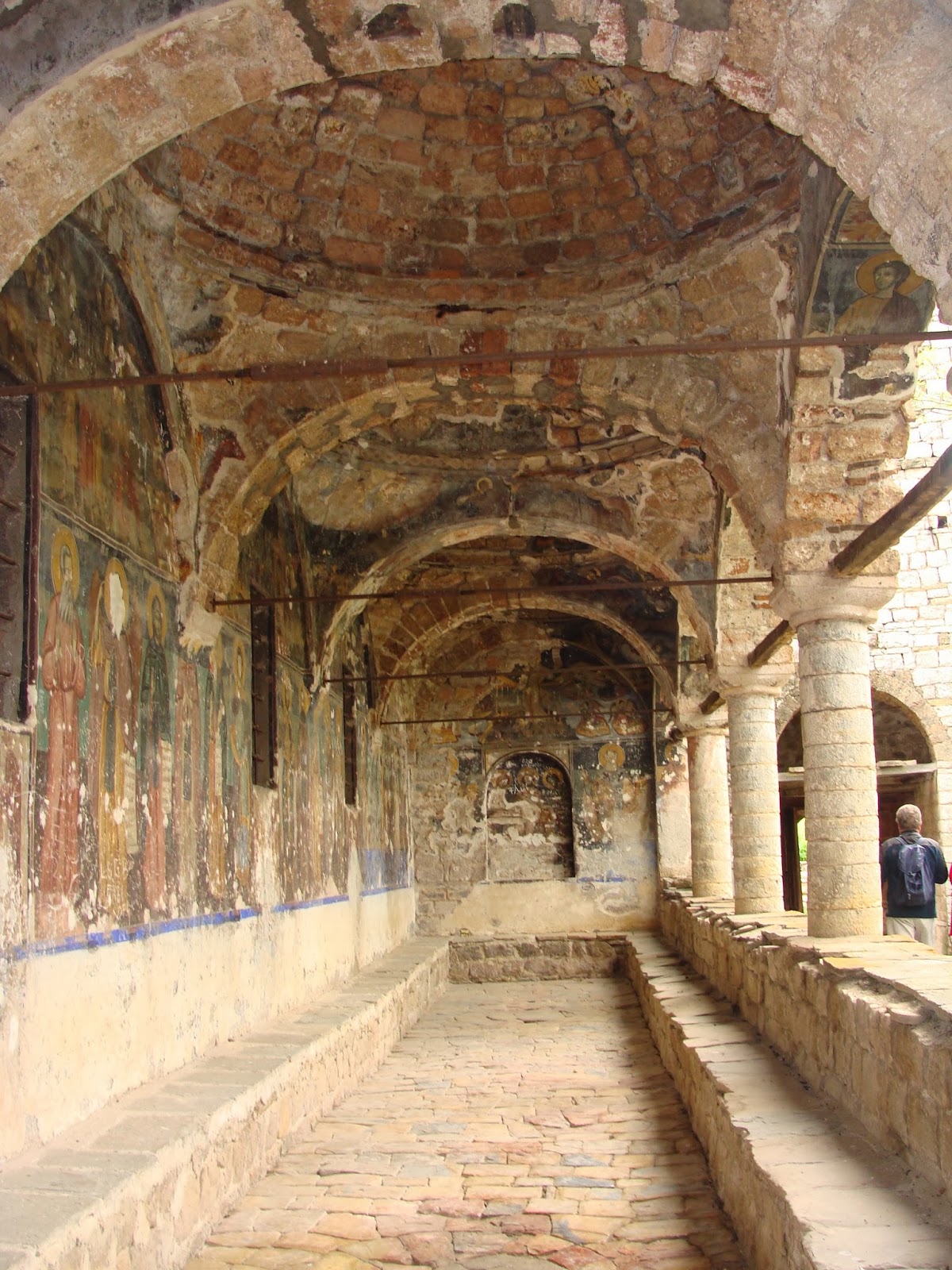
Frescoes in Voskopoja

And then you have Albanian churches.  During the Communist era, all forms of religion were outlawed and Albania was officially designated as a secular state.  Many, but not all, of the churches and religious icons were destroyed and religion of any kind was not practiced publicly.  (Fortunately, some of the more historically valuable icons were spared destruction and are now housed in a museum in the city of Korce).  Today, Albania is a religiously tolerant country that on paper is predominently Muslim but it has its share of Catholic and Orthodox churches as well.  Old churches and monasteries exist in various states of (dis)repair but for the most part they lack the ornate trappings found in so many other churches.  In some churches you can see remnants of frescoes and other religious icons but in others you encounter nothing but barren stone walls.  The hilltop town of Voskopoja, once a thriving commercial hub in the Balkans but now a small village with numerous churches in various conditions, is undergoing a renaissance of sorts where her ancient churches are being painstakingly restored.  Many of them exist as piles of rubble or nothing but shells of their former selves.  New religious buildings of all faiths are being erected throughout Albania as well.  These contemporary structures may lack the grandness of older churches, but regardless of the trappings, they serve their religious purpose.  I've learned that visiting an Albanian church, regardless of its denomination, is a solemn affair but then again, this speaks directly to the history and culture of the country. 

Nuremberg, Germany
But the message I get from visiting an Albanian church is no different than visiting one in nearby Greece or Macedonia or France or Sweden.  The religious beliefs practiced inside the walls may differ and some may be more ornate than others but all are symbolic of their people and the times in which they were built.  For me, walking into any church is like stepping back into history.   And houses of worship are an vital part of Europe's long and storied history.


Saturday, November 1, 2014

Here We Go Again

Its that time of year again. And no I'm not talking about Thanksgiving, Christmas, shopping sprees or winter. That time of year is the annual NaBloPoMo challenge where bloggers across the world are challenging themselves to blog every day during the month of November. This is my third go at it. The first year I did blog every day; the second year I almost made it but life got in the way. This time I'm determined to once again blog every day.

Will each blog post be profound? Probably not. But that's OK by me because for me, NaBloPoMo is about a personal recommitment to myself and my writing. For me, writing is my "me time"; the time when I can reflect on both the macro and micro worlds around me. It is a time that is important for me as a wife, mother and individual. The time may be short and many times rushed but when I blog its all about me. My thoughts and my opinions. When I'm writing I'm not cleaning up or cooking for someone else; I'm not driving from point A to point B and I'm not worrying about taking care of someone else. Rather, I'm taking care of myself by focusing on myself for a brief moment or two. And while I try really hard to do this on a daily basis year around, in November I make a concerted effort to make this happen.

So amongst the rush and chaos of a daily life that moves on fast forward from here until the end of the year, I'm taking a few minutes each day to concentrate on my writing. What I produce may be silly, serious or inane. It may be filled with words, pictures or a bit of both. But something will appear on this page every day for the next 30 days because that is my promise to myself.

Thank you NaBloPoMo.