Monday, August 5, 2013

Digging Around In The Past

Pottery shards on display in the Pella Archaeological Museum
There is old, then there is really old.  For me, my celebrating a significant birthday is getting older but it pales in comparison to those people celebrating much more significant milestone birthdays.  Boston, a city near and dear to my heart is old by American standards but she is a mere babe compared to the much older grand European cities.  The Egyptian Pyramids, Stonehenge and other ancient sites have withstood time and are even older.  And then you have the great cities and empires that no longer exist but whose evidence remains today; these places fall into the ancient category.  Greece is one such place where everything seems to be either really old or ancient.  We've been exploring this historic part of the world over the past week and it has me thinking about what constitutes old.

Whenever I am in Greece I immediately conjure up memories of reading about mythology and ancient Greek history in my high school literature classes.  At the time, sitting in an American high school, all of this seemed so foreign to me, yet today as we drive by brown historic markers identifying places I had only read about, it all begins to feel real.  These places are so much more than a story on a dog-eared page; they were home to thousands of people who lived, worked, and eked out existences under often harsh conditions.  And these weren't simple settlements, they were thriving metropolises whose architecture, infrastructure, and systematic layouts rivals today's much more modern urban centers.  They thrived, faltered, and through the diligent work of archeologists and historians, many are being revived.

An ancient relic that has survived
relatively intact
Last week we spent a day following in the footsteps of Alexander the Great in the ancient city of Pella. Located in the heart of the Macedonia region in northeast Greece, the area has been ravaged by natural disasters and time itself.  Like so many of its contemporaries, the excavation of this city, which was the birthplace of this ancient Greek hero, is a work in progress.  While parts of the site, including numerous mosaics, have been fully excavated, work was continuing in other areas.  During our visit on a blazingly hot July day, archeologists (probably unpaid college interns eager to gain hands on experience) were toiling away in the sun hoping to uncover new treasures.  Some pieces are likely to be uncovered intact while others will appear as mere fragments of their original selves, yet each is special since it is a tangible piece of the past.  We gingerly walked through the site then seeking to escape the heat, we sought shelter in the Pella Archeological Museum where previously discovered relics, including an impressive number of mosaics, were on display and protected from the elements in a well air conditioned building.  A surprisingly large number of fragile looking pieces were completely intact making me wonder how they survived the test of time while others did not.

Just a small portion of the excavated site at Pella; work was ongoing
with other areas being excavated
As I have many times before, when I stand amidst these ancient ruins that have been uncovered, excavated, and (hopefully) protected, I wonder how much of these ancient lands have yet to be (re)discovered.  The designated boundary to the protected ruins may sit mere meters away but what lays beyond the fence waiting to be uncovered?  In Pella, are treasures waiting to be discovered underneath the modern village and acres of farmland that surround it?  Are someone's farm animals unknowingly grazing on a historically significant site?  Fragments of the original roads wind their way through the Balkans towards the sea.  In places we've seen the original well worn cobblestones sitting alongside dirt and cracked asphalt.  And this is in rural areas but digs in urban areas are just as likely.  It is a common sight in Europe to come across the remnants of an ancient city, wall, or building right in the middle of a modern urban center with each infringing upon the other.  These sometimes fully intact ruins are often discovered while laying  a new road or erecting a new building.  These accidental discoveries make me wonder how much of the area has already been unknowingly destroyed.  Did a backhoe inadvertently scoop out a pile of dirt that really had historical significance?  Will we ever know if it did?  How do we preserve the past while moving forward in a modern world?  Where does the need or desire for a new road or building outweigh historical significance?  These are the questions I often ask myself.

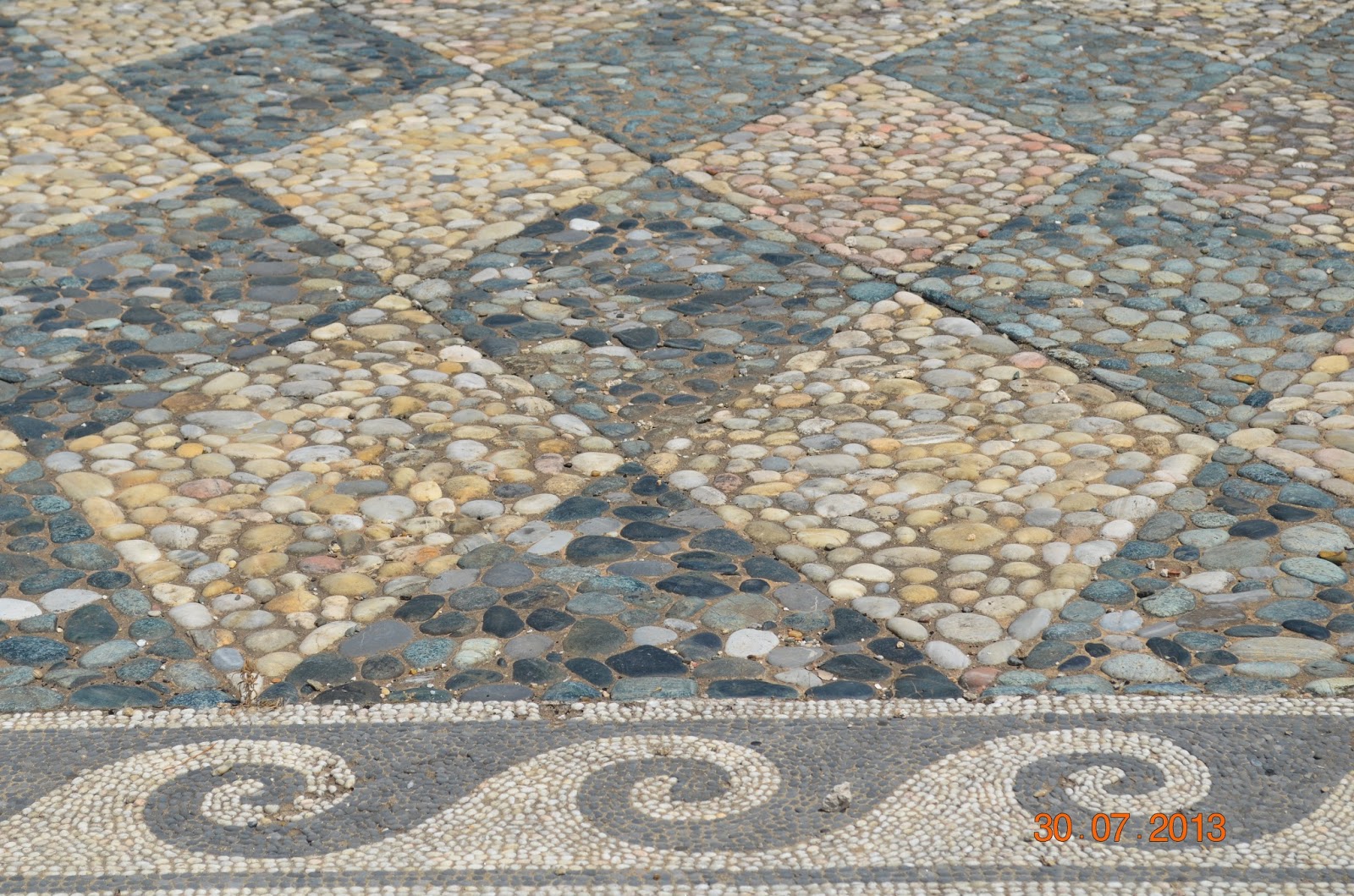
A close up of the mosaic work; it amazes me to think that
these tiny stones are intact having withstood time for
centuries

Saturday, August 3, 2013

The Other Greece In The Other Macedonia

Graffiti
There are two Greeces and two Macedonias.  The first Greece is the aquamarine island covered one filled with small fishing villages, fresh seafood and boats carrying sun-kissed  tourists.  The other Greece is the breadbasket of the country; rural, rugged, and decidedly untouristy.  The first Macedonia is the a fore mentioned northern most region of Greece; the second Macedonia is technically the Former Yugoslav Republic of Macedonia (FYROM), an independent country north of the Greek border that is recognized by most of the world yet whose name is disputed by its southern neighbors.

While the FYROM will be the last leg on our Balkan adventure we visited the Greek Macedonia early in our trip.  We had returned to Greece again with the goal of exploring the central and eastern environs of the country.  We clambered over the hills and monasteries in Meteora before setting out for Thessaloniki and the Aegean Sea in the east.  I'm not sure what we were expecting to see along the way--perhaps the sun drenched coast and quaint fishing villages that beg tourists to visit.  Instead, our drive took us through the flat and dusty plains of central Greece.  The roads were mostly in good condition alternating between freshly rehabilitated and still under construction leaving us to rely on common sense rather than our GPS.  The land was alternately rugged and somewhat fertile with farm tractors far outnumbering private vehicles.  We drove through one small town after another with each looking more forlorn than the last.  Greece's economy has been on a downward spiral for some time and this was so apparent as we drove through kilometer after kilometer of the countryside.  Even in the middle of the week businesses appeared to be shuttered--with the exception being places selling farm equipment.   We had lunch one day in the mountain village of Edessa where the highlight of our visit was their giant waterfalls.  (Well, the highlight of Sidney's day was watching a graffiti covered train come through the station while we were eating lunch nearby).  The waterfalls were a pleasant surprise but their beauty was marred by the obvious neglect that surrounded them.  Grass and shrubs were overgrown and then there was the graffiti. Graffiti seems to be the national signage of Greece with everything from road signs and buildings to trees and even vehicles being covered with the colorful artwork (?), vandalism (?) symbols of free expression (?).  There was just graffiti everywhere.

Standing under the waterfalls of Edessa

Taking a break from exploring the Bey Hamam in Thessaloniki
And yet more graffiti
Thessaloniki, Greece's second largest city after its capitol Athens, wasn't quite what we had been expecting either.  With the city sitting on the edge of the Thermaic Gulf I had visions of crystal waters and fresh fish gracing every menu.  Instead I was disappointed to hear that because of the rampant pollution the water was neither clean nor the source of the fish on restaurant menus.  The streets were filled with people but they appeared mostly to be disenfranchised youth lounging at cafes or hanging around the waterfront.  Again, the amount of graffiti here was unbelievable. Maybe it is because I have worked in inner cities for so long but the sight of that much graffiti had me wondering about the levels of crime and personal safety of the area.

Thessaloniki is a city with a long history so we were excited to visit her most famous landmarks.  Despite the intense July heat we dutifully set out to explore the area.  The Bey Hamam didn't disappoint.  Having visited a functioning hamam in Istanbul we knew what to expect and enjoyed following Sidney through one chamber after another exploring each nook and cranny.  The Roman Agora in the heart of Thessaloniki was another surprise.  It still amazes me that in this ancient part of the world one minute you can be in the midst of the hustle and bustle of the modern city and in the next you are standing in the middle of ancient ruins.  Now that is cool.  What wasn't so cool however; were the boarded up graffiti covered store fronts that circled the ruins.  The juxtaposition between the preserved old and the neglected new was ironic.  There were other sites we had hoped to visit but upon arriving at them we found them shuttered.  (I don't think it was the day of the week we were visiting either because by the looks of the overgrown grass these sites hadn't been opened to the public for some time).  What we did find were restaurants that were open for business and knew how to treat customers right.  While none of them were full all were eager to serve us and staying away from fish, we were treated to some of the simplest but tastiest food we had eaten in a long time.  It wasn't fancy but it was served with a smile and as Sidney said, "made his tummy happy".  Now it really doesn't get much better than that.

A beautiful view of a not so clean bay

I wanted to like Thessaloniki and the Macedonia region of Greece; I really did.  It is Greece after all!  So many people had raved about the region that I was excited to visit. Perhaps I had set my expectations too high.  Or as Glenn said, after all of the traveling we have been doing in the past couple of years, it was time we experienced a dud.  I can honestly say that Thessaloniki and the Macedonia region of Greece is an area I won't be rushing back to.  Perhaps we missed out on the real treasures but I left there feeling a bit depressed and wanting a bit more.  Or perhaps I need to stick to visiting Greece's islands.  I wanted the area to be cleaner, brighter, and better cared for.   As a first time visitor I'm not sure if the conditions we saw are a direct reflection on Greece's fragile economy or if that is the way the city has always looked.  I hope it is the former since that gives me hope that it can turn around when the economy rebounds.  I do love this region's wine though, and am pretty sure I will be able to find it at home.  That will be my Thessaloniki / Macedonia / Greek souvenir.


Ancient ruins right in the middle of the city

Tuesday, July 30, 2013

For Your Eyes Only: The Monasteries Of Meteora


The Roussanou Nunnery
James Bond's For Your Eyes Only was filmed here.  These bizarre granite nubs located 300 meters above the plain in Central Greece are truly a sight to behold.  Meteora literally means "midair" and this aptly describes both the hilltops and the numerous monasteries that are perched atop them.  I first learned about the Meteora Monasteries when I saw the cover of Frommer's guide to Greece.  The picture of a lone building sitting atop a cliff was intriguing and I wanted to learn more.  My research told me that 30 million years ago this entire area was a vast inland sea and when the waters receded, they left these rocks behind.  This would explain the gnarls, carvings, and swirling patterns that only erosion by water could create.

Long view


Close up of the water (and weather) carved rocks
It is believed that during the 10th Century monks first lived as hermits amongst the numerous caves that are a part of the hills.  As more monks came to the area the first monastery, the Great Meteoro, was built in the 14th Century by St. Arthanasios.  Fast forward one hundred years and there were 24 monasteries dotting the Meteora hills.  Solitary life was far from easy in these monasteries.  While the high altitude provides relief from the stifling temperatures in the summer, high winds make for very cold winter days.  Everything, from building materials to food and water had to be carried in.  There were two ways to reach the top of these hills; you could either climb steep paths or you could utilize a rope, basket, and pulley system to hoist goods from the ground to the top.  Both methods are still utilized today.

Now this holds a lot of wine

Today only six remain open to the public.  While a paved road now takes visitors to the base of each monastery, long treks up numerous steps are still required to make it to the top.  (As we learned, in the July sun, that means it is a very hot climb).  But as we discovered, the effort is well worth it.  We visited three  monasteries during our visit to Meteora.  Megalo Meteoro, or the Grand Monastery, was by far the largest.  The views from the top were breathtaking and we loved exploring the nooks and crannies that were open to the public.  We explored the vast wine cellar and discovered that these monks loved their wine as they had casks and barrels of all sizes.  The "old kitchen" while well equipped, looked like the preparation of every meal would have been  tedious production.  In the ossuary, which was filled with row after row of skulls, we saw the shrine to the deceased monks.  Upon entering the chapel, dark yet opulent and smelling heavily of incense, even Sidney immediately fell silent.  Back outside in the bright sunshine he perked right up as he spied a water fountain which was a welcome sight in the midday heat.
Dead monks

On the next hill over, we visited the Varlaam Monastery which while smaller than the Megalo Meteoro, provided us with amazing views of where we had been.  The visit to the Roussanou Nunnery required the steepest climb but the sweeping views made my initial fears worth it.  (This entire day was a challenge to this height fearing traveler).  While all of the monasteries were well kept, the grounds of the nunnery seemed more immaculate.  The building itself felt more compact and we didn't see any evidence of wine making on the premise.  Whereas the entrances to the monasteries had been manned by slovenly looking young men, nuns were at work in the nunnery collecting admission fees and monitoring the attire of visitors.  (Women are required to wear skirts inside all of the monasteries and those who weren't already wearing them were provided with scarves that could be transformed into hastily made wraps.  Men were supposed to be wearing long pants and as Glenn suffered through the intense heat in his we saw many men entering these holy places with knobbly knees showing).  We also witnessed nuns sitting in corners of the nunnery silently making handcrafts.

All of the Meteora Monasteries were impressive but what I found the most awe inspiring was the physical location of each holy place.  Perched upon the top of these hills, I continued to wonder about the effort and sheer willpower that constructing each of these buildings must have entailed.  Which option was better- trekking goods up the hill or hoisting them in a basket?  I couldn't decide which view was the most impressive: the top of the hills looking down provided one perspective but sitting at the bottom looking up was equally awe inspiring.  The sweeping view from our hotel room balcony provided yet another perspective.   I enjoyed all of the views.  Everyone says that the best time to visit the area is in the winter when the hills and monasteries are snow covered.  Now if only we can schedule a return visit to see if we agree.

Meteora is in the middle; the Pindos Range is in the background


The morning view of the mountains as seen from
our hotel room

Night time perspective

Saturday, July 27, 2013

And We're Off

If only our route was this straight (or paved)

Last year when opportunities for travel arose, we were quick to get out of Albania and our little part of the world.  We visited Italy twice, made pilgrimages to Istanbul, Budapest, and Prague and spent our summer holiday exploring Scandinavia.  This year, however, we've been embracing the Balkans and discovering the hidden treasures that lie in this little part of Eastern Europe.   Today we head out on a two week road trip through northern Greece, Bulgaria, Romania, and Macedonia.  We're excited to explore this part of the world that just a few years ago we never would have dreamed of visiting.  With the exception of Greece, when we were growing up these countries either didn't didn't exist or were places whose conditions were so brutal that westerners just didn't thinking about visiting them.  But things have changed.

And now we're off.  I think I've packed everything but if I haven't I will only realize it later and by then it will be too late so we will do without.  Passports and the camera are in my purse.  Snacks are packed, batteries for various entertainment systems are fully charged, and this time we've remembered to bring along our CDs since channel surfing on the radio is frustrating at best.  For the most part we know where we are going.  Our hotels are programmed into our GPS and once we get across the Albanian border the GPS will hopefully come alive with maps.  (The entire country of Albania shows up as a big black hole on our TomTom).  People have joked that this trip could give the Griswold's family vacation a run for its money.  Maybe it will, maybe it won't.  Summer vacations are supposed to be about family time and making memories and that is sure to happen.  We may not know what is around the next corner but we're about to find out.

First stop:  Meteora, Greece.

Friday, July 26, 2013

An Issue Of Image


Following in true European summer tradition, we are about to set off on our annual two week holiday.  Last night, in preparation for our excursion, I decided to check out the hotels where we have reservations for the coming weeks.  Glenn always takes the lead in booking our hotels and, as he has yet to make a bad choice, I rarely bother to see where we will be staying prior to the rooms being booked.  As has been the case, all of the hotels where we will be staying look very nice online.  This time, however, I noticed something that I hadn't seen on the websites of other hotels where we have stayed.  Each and every site had too thin, scantily clad women gracing their sites.  Whether it was the lone woman taking in the night view from the balcony wearing the sheerest of "evening" dresses, or the one soaking in a jacuzzi, or yet another splayed across a satin sheeted bed, it would seem that sex is being used to market these otherwise respectable, name brand hotels to prospective customers.  This wasn't for a single hotel mind you; rather it was for several spread across four different countries.  Now I've done my share of traveling and this is the first time I've seen such blatant sexuality used to market reputable hotel accommodations.  And all of these "models" were women who look nothing like the typical ones I see every day.  Who exactly is the target audience?  Is the assumption that only men are making hotel reservations?  And speaking of men, where are they?  Are these women really traveling by themselves? And if so, who hangs out in their hotel rooms dressed as they are?

This marketing campaign has me thinking about body images and how they are perceived, used, and manipulated around the world.  A five star hotel in the United States is more apt to use the image of a sophisticated couple or a businessman or no people at all on their website while it seems as though single women are what sells in the same five star accommodations in Eastern Europe.  In fact, scantily clad women seem to be used to market most things in this part of the world (and others as well.  I know this phenomenon isn't unique to this region but it does seem to be a bit more over the top here).  From restaurants and bars to automobiles, soft drinks, and yes hotels, busty skinny women wearing little clothing are hawking products everywhere I look. What messages are these advertisements sending to today's young girls about what they should look like?  And more importantly, how do we as ordinary people counter the glitzy and sexualized images that come at us from all directions?

In my younger years I might have (and did) viewed these images and wondered what I had to do to look like these idealized women.  Now that I am older and wiser I understand that I will never be six feet tall nor will I be a size 2 and I am more than happy with that.  Do I love the way I look?  Some days I do while on others I don't.  Over time I've learned to deal with both the things I like about my body and the things I don't.  It isn't always easy when I look around me, but I'm doing the best I can.

But I am also hopeful.  During recent beach excursions I saw European women of all ages, shapes, and sizes enjoying the sun and sand.  While I was clad in what I consider my age and body appropriate Lands End swimsuit, everyone else was wearing much smaller and more revealing swim wear.  (Or wearing nothing at all).  And you know what?  I didn't see a single body that looked anything like the glossy images that stare down at us from billboards and websites.  Many of the women around me had sags, bumps, and wrinkles---the skin and bodies of real women--- but they weren't letting that stop them from enjoying themselves.  I found it deeply refreshing that regardless of the images that are so prevalent, so many of these women were comfortable in their own skins.  Perhaps media doesn't have the influence I think it does.  At least I can hope.

Tuesday, July 23, 2013

Discovering The Albanian Riveria: Dhermi

The best of the Albanian Riviera

The Albanian Riviera. If you aren't from Albania or haven't traveled through the Balkans, you have probably never heard of it.  Or maybe you read about the area when the New York Times featured the region in its Frugal Traveler section.  If you are familiar with the region and have been there, then you know what all of the fuss is about.  The Albanian Riviera extends from where the Adriatic and Ionian Seas meet at the coastal city of Vlore south to the border where Albania meets Greece.  Just over 80 miles in length, due to narrow roads, random animals in the road, and the sweeping views, driving its entire length can take hours.  (And this isn't necessarily a bad thing).  Approaching the area from the north means traversing a narrow hairpin road up through Llogara Pass then weaving your way down to the shore below.  On a clear day, the vistas more than compensate for the slow going. This area includes the coastal villages of Borsch, Qeparo, Himara, and Dhermi as well as the larger port city of Saranda and was recognized as a 2012 top value destination by Frommer's.  The mostly pristine beaches along this stretch of coastline are pebbly but the crystal clear water invites visitors to jump right in and forgo stepping on the rocks.  Many are inaccessible to all but the most sturdy of vehicles as are numerous castle ruins perched atop soaring cliffs.  The area is known for its rich olive oil and fresh seafood and due to the region's proximity to Greece, there are Greek influences in everything from the area's culture and language to its food.  Like the rest of the country, the history of this region runs deep; it has been settled, invaded, occupied, and been the site of battles since ancient times.  Albanian history cites an attack by Phillip of Macedonia (father of Alexandria the Great) on the village of Himara in 214 BC.  Now that is some ancient history.

View from the beach

We had been hearing about the natural beauty of the Albanian Riviera since we arrived here and had driven through on several occasions en route to other destinations, but had never spent a substantial amount of time there.  We always meant to really visit but other than lunches at roadside fish shacks or an afternoon exploring the cavernous Porto Palermo castle, the area had been nothing more than a view out the car window.  This past weekend we had the opportunity to spend the night (two of them in fact) and experience the area of ourselves.  We were the guests of a friend whose family has owned property in Dhermi since the early 1900s and as such, he was privy to the best spots in the village, introduced us to them and gave us a sense of what the area is really like.

I've often said that the best way to discover an area is to live like a local and that is what we did.  Sure you can see a lot when you rush from one historic or must see site to another but in doing so, are you really experiencing the area?  As guests in our friend's home we were able to sit on the balcony and enjoy the water views.  Whether it was a morning coffee or an evening glass of wine, the rising or setting sun and the cool breezes off of the water only amplified our feelings of tranquility.  Repeatedly we found ourselves wondering how we could still be so close to the hustle and bustle of Tirana yet feel a world away.  The air was so much cleaner in Dhermi than it is in the city and although the village is gearing up for the height of their tourism season, the pace of life around us felt sleepy and relaxed.  It was impossible not to join in on the feeling.  We spent the days lounging on the beach in a far off section of waterfront that had been under guard and off limits to all but the party elite during Communist times.  Even today, at the far end of the beach, it was separated from the more lively boardwalk-type area.  It was so easy to loll away the hours while just looking at the water.  Our meals were casual affairs filled with fresh fish and seafood that had just been pulled from the sea. It was so fresh, in fact, that we selected which fish we wanted from a still squirming selection that was presented to us on a platter.  (We also discovered that we actually know more people that we think here in Albania.  On two separate occasions we encountered Albanians we had previously met at other locations thus proving just how small of a country this really is).  In reality, our weekend was filled with doing absolutely nothing and it was just perfect.

The southern view of Llogara Pass

After any trip I always feel a sense of sadness when it is time to pack up and return home.  I call it a post vacation let down.  Despite of, or maybe because of, our only being away for two nights, I left Dhermi desperately wanting to experience more of it. It was so idyllic that I wanted to spend more time just sitting and absorbing the sun, sand, and fresh sea air. But all is not lost; we've consulted our calendars and are planning a trip back this fall. I've been told that the area is even more beautiful at that time of the year and I can't wait to go and see it for myself.

And of course, no trip to the beach would be
complete without a few rocks being thrown


Friday, July 19, 2013

Little Pitchers Have Big Ears

I'm raising a little boy. As such, his current obsessions include cars, trains and airplanes.  From watching their wheels go around while playing with cars and constructing a maze of tracks throughout the living room for trains to providing detailed (bi-lingual) descriptions of what one needs to do in order to fly on an airplane, Sidney spends hours fixating on these modes of transportation. Upon boarding a hydro-ferry recently Sidney saw the seat configurations and proclaimed that it was just like riding an airplane.  He really is such a boy!  In many respects this works out well for us since the lure of an airplane or train ride during an upcoming trip is enough to prod my otherwise pokey boy into picking up his toys, cleaning up his room, or even finishing his dinner.  (I am not ashamed to admit that, on occasion I will resort to bribery).  Yes, travel by any of these modes of transportation is just that exciting for him and we take full advantage of it.  Because of this, all is well until it just isn't any more.

During our recent trip to Greece our hotel was situated near the airport. While most people would probably be turned of by this, the location worked out well for us since it provided hours of anticipatory entertainment because you never knew when a plane would land or take off and you had to be on the lookout.  A routine quickly developed.  Sidney would first hear the plane then upon spotting it would shriek with excitement and point at the sky to inform everyone within ear shot of the airplane.  His excitement became a joke amongst our group and soon everyone was on the lookout for the next airplane.  During our final night on the island we were playing the same game during dinner.  At one point during the long evening a conversation a few chairs down from Sidney turned to the recent crash of a U.S. military plane in Afghanistan.  The voices were low and I was only hearing bits and pieces of the conversation while Sidney appeared to be focusing on eating his dinner (and playing with a match box car) so I didn't give the conversation much thought.  That was until one of our fellow diners spotted an outbound plane and alerted Sidney.

What did my airplane loving boy do? Instead of pointing and yelling with delight he looked at me with tears in his big blue eyes and informed me that it was bad and the people on the plane were scared. Using his hand, he then mimicked the actions of a plane taking off before abruptly changing direction and crashing onto the table next to his dinner plate.  All conversation around us stopped as we quickly assured Sidney that the plane and its passengers were safe.  He nodded and returned to his dinner but with the spotting of the next plane he again stated that the passengers were scared.  When this pattern continued for the rest of the evening and started again the next morning, I began to wonder how I could address this fear. 

As our (bad) luck would have it, later that morning our group toured the grounds of the Gjirokastra Castle which includes the remains of a 1950s era U.S. military plane.  Our English speaking guide shared the original story of how the plane came to be there (the Albanian military shot down the insurgent aircraft) then the real story (it had mechanical trouble and was forced to land). I don't know how much of this Sidney heard because he was focused on the "broken" plane in front of him.  Glenn and I quickly ushered him away from the wreckage but the image had already been set in stone in Sidney's young mind.  Once home, and still pondering how we should proceed with Sidney's new found fear, we made the mistake (?) of turning on the television to try to catch up on the news.  And what was the first image we saw?  Nothing other than the burned out wreckage of a crashed plane sitting on the runway at the San Francisco airport.  We quickly shut off the television but I fear it wasn't fast enough since Sidney was in the room.  Even two weeks out from our trip Sidney still talks about airplanes being bad, the broken plane, plane crashes, and people being scared.  As if this wasn't bad enough, in the same two weeks we have heard and seen stories about a freight train exploding in Canada and a commuter train crashing in Paris.  To my knowledge Sidney is still oblivious (I hope at least) to these incidents since, while he still likes to crash his trains while playing with them, he hasn't indicated that he is afraid to ride them. In fact, he even asked if we could take a train to Poland this fall instead of an airplane.  (The answer is no since Albanian trains really are that scary). We just need to make sure it stays this way.   

The old adage really is true.  You never know what children will hear.  No wait, I take that back because they hear everything.  My lesson from all of this?  Assume Sidney will hear and see it all even if he appears to be oblivious.  And now we have to figure out how to counter his newly found fears.  I know I can't shelter him from every tragic event and the day will come when I have no control over what he does and doesn't see and hear, but in the meantime I want to protect him. I want my airplane and train loving little boy back.  I want him to feel safe and excited about these modes of transportation.  Heck, if need be, I'll even join him in playing airplane for hours on end.