Back in the land of donkeys and furgons............
 |
| In case we weren't sure where we were....... |
After an all too quick jaunt across the border into Macedonia, our caravan returned to Albania and the land of donkeys and furgons. We were met at the border crossing by the return of our military police escort and the sight of bunkers lining the shore. Whereas the roadsides in Macedonia had been litter free, Albania's were strewn with trash piles, half constructed concrete buildings, donkeys, and random people.
Yes, donkeys. (Here's a fun fact- Albania has more donkeys per capita than any other country in the world). They are especially prevalent in the southern part of Albania where the sight of a donkey or two on the side of the road, in the middle of the road, or on a hillside is such a common sight that after awhile you stop noticing them. The only thing more prevalent than donkeys are furgons, the rickety mini-buses that serve as Albania's most reliable source of public transportation. You see them everywhere in the country, packed with people and barreling around sharp curves in the road. If you stand on the side of the road one is sure to stop for you- hence the random people standing on the side of the road. (I need to look carefully to determine whether the roadside bystander is watching his donkey or waiting for a furgon). I'm not sure what is more dangerous, riding in one (which we are not allowed to do), meeting one head on (since they are often on the wrong side of the road), or following behind one (they will abruptly pull over to the side of the road to drop off passengers or pick up new ones with complete disregard to other vehicles around them).
During our weekend we stopped in some of Albania's larger southern cities- Elbasan, Korce, and Pogradec all warranted brief stops for either coffee or a museum tour. The cities themselves, like Tirana, Durres, and Shkodra to the north, are polluted, traffic clogged concrete jungles. Former industrial centers during the Communist Era, they are now unattractive litter filled urban cores. What historic sites may have existed are, more often then not, neglected shells of their former splendors. Elbasan Castle, which at one time was part of Albania's impressive countrywide defense system, has been converted into a hotel and coffee bar. While slightly interesting, it lacks its former magnitude and now looks like a copy of the hundreds of other stone facaded cafe/bar/hotels scattered around Albania. I found our visit to Korce's mosque and Museum of Albanian Medieval Art disappointing. Both sites had a neglected feel to them and it saddened me to see relics from Albania's rich religious past being minimally preserved.
 |
| Unspoiled mountains |
 |
| Voskopoja church |
Albania's true beauty lays in her rugged mountains and rolling hills. Between the more urban- by Albanian standards anyway- population points lie thousands of acres of wild, undeveloped, and minimally accessible forests, rocky mountains, tiny hamlets. Whether they are in the north or the south, these are my favorite parts of Albania and are the reason so many people find Albania to be a truly beautiful country.
We spent the second night of our trip high in the mountains above Korce in the village of Dharda. Our
hotel was surprisingly well constructed and finished. Many Albanian restaurants and hotels may look finished from the outside but the insides lack basics such as lampshades on lights, plate covers over electrical outlets and trim around doorways and windows. Restrooms tend to be particularly bad with many of them being a half step above a pit toilet. (Glenn calls it the 70% rule with things being pretty on the outside but rough and unfinished on the inside). The best part of our stay in Dharda, however, was the views of the mountains and the sheer wilderness that surrounded us. At night the sky was unspoiled by the lights of the city and the air was the cleanest I've experienced since arriving in Albania. Sheep and donkeys definitely outnumbered the human population in this community and even in the rain it had a sense of peacefulness to it. Dharda is a beautiful place and one I'm sure we will return to.
Our visit to the mountainous "tourist" village of
Voskopoja necessitated driving over rutted mud filled roads, through the Sunday morning animal market, and sprawling mountain passes filled with grazing sheep and soggy shepherds. If you looked beyond the dangerous road conditions and avoiding looking down at the garbage filled creeks that ran through the villages, you were rewarded with views that rival those found in more popular parts of Western Europe. Upon reaching Voskopoja, I once again had the sense of a place having so much potential but the inability to execute a plan. In 1764 Voskopoja had 24 churches and was the largest city in the Balkans. Today most of those churches are in ruins. One is well preserved and renovations are underway to restore another. The rest of the village consists of a smattering of cafes, half built concrete structures and neglected stone buildings connected through a series of mud, stone, and manure filled roads. As a college history major with a professional background in urban planning, I viewed Voskopoja as another yet Albanian village with immense potential. Unlike truly isolated villages hidden in mountain valleys, you can find Voskopoja on maps and in the few existing guidebooks on Albania. Done correctly, and sooner rather than later, a planned preservation of Voskopoja could serve as a model of how Albania could do tourism right. Sadly enough, I don't think the village or the country is ready for it.
 |
| Up the mountain towards Dharda |
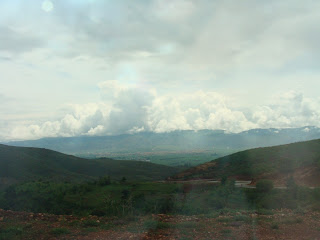 |
| Rolling hills outside of Korce |
Our long trek home took our caravan along the Albanian shores of Lakes Prespa and Ohrid. Although less developed than the Macedonian side, the water on the Albanian side was murkier and less attractive. Old men selling fish from shacks lined the narrow stretch of rocks between the lake and the poorly maintained road. We were deep in the heart of donkey-country as the number of braying animals clearly outnumbered the human population in this part of the country. Lunch was a meal of fresh fish eaten at a "70% Albanian restaurant" overlooking Lake Prespa's famous
Golem Grad, or snake island. Again, there was so much unrealized potential in this area that the entire experience saddened me.
Albania is a very mountainous country. Our final push home took us farther along Lake Ohrid through Pogradec and over one set of mountains and down into the city of Elbasan. In between the cities the mountain views left us speechless as we drove for miles (or kilometers) with nothing but undeveloped land around us. The drive up into the mountains from Elbasan left us equally speechless but it was more from the fear of the steep grade of the road and the hairpin turns that spanned the mountains. Although well maintained by Albanian standards, the sheer drop offs with nary a guardrail or painted line put fear into my heart. (Young boys standing on the roadside selling strings of fresh cherries only added to the sense of danger since you never knew which sharp corner they would be standing around). As Glenn drove along I was torn between wanting to take in the sights and my fear of looking down. A magnificent double rainbow only heightened the beauty of the experience.
It is hard to believe that such amazing beauty can co-exist in a country filled with too much concrete, too many cars and the worst air pollution in Europe. Due to its geography, so much of Albania remains inaccessible and off limits to all but the hardiest soles who call the mountains home. As is evidenced by the uncontrolled sprawl that has spoiled so many parts of Albania, it is this inaccessibility that has kept large swaths of Albania preserved. New roads are continuing to be constructed and in a pre-election year, politicians are promising that these highways will soon be complete and dramatically decrease travel times between cities. Increased roads will mean increased traffic and the corresponding problems of pollution, unfettered construction, and too people with a complete disregard to their natural environment. I'm afraid that instead of increasing opportunities for the Albanian people, increased accessibility will actually decrease the quality of life for the majority of its citizens, further endanger Albania's natural resources, and do little to preserve its historic landmarks. This makes me sad.
 |
| "Snake Island" in Lake Prespa |


