Sunday, August 18, 2013

Taking In A Statue (Or Two) In Skopje

A city being rebuilt: the
bronze dome of the new
 municipal water
building
Skopje, Macedonia, a.k.a. FYROM, was the final stop on our Balkan road trip. We pulled into Skopje on day 13 of our journey hot and a bit travel weary but excited about what we would find.  Friends who had lived or spent time in Skopje had told us that it was a wonderful city that was undergoing a grand renewal so we were ready to see this for ourselves.  After all, each of the other Balkan capitols we had visited had pleasantly surprised us so we expected more of the same here.

I had been told that Skopje was a city full of statues but until I saw it for myself, I didn't fully comprehend what this actually meant.  Seeing as Skopje is a city in a former Communist country, I fully expected to see my share of statues portraying stern looking men armed with weapons.  After all, these nationalistic statues had graced every city and town and many of the roadsides we had traveled through over the past two weeks so it would make sense that Skopje would have more of the same.  But what I saw in Skopje was different.  Very different.  Sure they still had their share of Cold War era monuments but new modern looking statues, monuments, and fountains were being built throughout the city at a scale unlike anything I had ever seen before.  Additionally, new municipal buildings, museums, theaters, and hotels were being constructed along the renovated riverfront.  Yes, we found Skopje to be a city under construction and it was all very exciting.

The Stone Bridge at night; a renovated original
Skopje is a city of contrasts. We wandered through the cobblestone streets of the old Turkish bazaar filled with its non-descript cafes, stores selling everything from gowns and precious metals to housewares and tourist trinkets, and abandoned buildings.  We climbed up to the Skopje Kale, or fortress, which dates back to the Ottoman Empire.  The grounds and fortress itself were in turn rebuilt, over grown, and somewhere in between.  In true Balkan form, resident dogs held court over the paths making me look twice before turning each corner.  The original walls had been refortified and from the top we took in the sweeping view of the city below us and the Millennium Cross perched atop the looking Vondo Mountain.  But the most interesting part of our experience in the city was the statues and monuments that appeared on so many street corners and public squares.  Upon returning home I did a little researched and discovered what this public art building craze was all about.

One of 15 equestrian statues

Under the moniker of Skopje 2014:  The New Face of Macedonia, Skopje aims to revamp its image by constructing twenty new public buildings, 15 equestrian statues, and a memorial dedicated to fallen heroes.  The center piece of the project is a grand, 22 meter high bronze statue of Alexander the Great that sits in the city's main square. (A corresponding one of his father Philip of Macedon sits on an opposing square).  During our visit on a very hot August night hundreds of people were in the square taking in the sights.  Children and adults, couples, singles, and teens alike splashed in the fountain as they took in the multi-colored water and light show that accompanied the classical music that was pumped into the square. The whole experience was simultaneously impressive, surreal, and over the top.  It was unlike anything I have ever seen before.  (Many of the other fountains also had light shows with both the lights and the music lasting well into the early morning hours).


Because words can't adequately describe the experience here are a few pictures to give you a better idea of what I am talking about:

Alexander the Great in all his greatness

Close up of the water display

Another magical display- all part of the Alexander the
Great monument

And there were other statues and monuments as well:


Saints

and heroes

This fountain (below) located immediately outside of our hotel was perhaps the sweetest of them all.  As series of mother figures flanked its perimeter.  Each mother held a child at a different stage of their childhood.  It was touching and unlike any of the other statues we saw.  And Sidney, of course, was more interested in the water than the touching significance of the figures.

I called this the mother-child fountain; all of the figures
portray mothers with children

Celebrating music
and theater
And then there were the public buildings.  A new municipal water building was being constructed with a shiny bronze dome.  (Who does this these days?).  It would only make sense that a new national theater, which itself celebrates arts and culture, located in a city celebrating public art on such a grand scale, would have its own statues.  Although much smaller in scale than the grand ones flanking the main square, the statues surrounding the still under construction national theater were the first ones we noticed as we made our way to the hotel.  In true new Skopje fashion, the theater building has statues flanking its entry ways and its grand veranda overlooking the river.  These were whimsical and a welcome change from the warriors perched on horseback.

Naturally, any project of this scale is going to have its critics.  People are unhappy with everything from the concept and costs to the architectural designs.  The contracting of public projects is big business all over the globe and as is often the case, accusations of a lack of transparency abound.  One year into the project officials are reporting that to date,  208 million Euro has been spent while critics place the number at a figure closer to between 500 million to one billion Euro.  (Either way, during these fragile economic times, that is a lot of money to spend).  Some claim such a project detracts from the larger issues that are pressing to many Macedonians.  High unemployment rates, potential NATO membership, and the ongoing name controversy that is hindering the country's entry into the European Union are issues that many feel need to be addressed before erecting new monuments.

Being neither Macedonian nor living there I have a different perspective.  As a tourist I was entranced by the spectacle that is the "new" Skopje.  We found the city to be a pleasant place to visit and one we would readily return to.  If the city's goal is to attract foreign tourism and we are any indication, they seem to be succeeding on this front.  As an urban planner I was pleased to see a level of thought and development that I have found lacking in most of the other Balkan countries and cities I have visited.   Having sat on both sides of the public project table I can only imagine the talking, planning, and negotiations that have gone into the implementation of this project to date and the amount of work that has yet to be done.  But having been involved in the implementation of large scale public projects, I am well aware of how much these endeavors cost.  During our short visit I repeatedly found myself wondering how the project was being funded.  Tax dollars?  Private investment?  A combination of both?  During lean economic times I wonder whether this is truly the best use of public dollars.  I do hope that the work is completed before the money and public will dry up.  Too often projects that begin as a good idea never reach fruition leaving a community no better off than they were before they began.  This I have seen throughout the Balkans.  For Skopje, only time will tell.  Regardless of it all, Skopje was a grand way to conclude our Balkan adventure.

Monday, August 12, 2013

Sofia Underground

Alexander Nevsky Cathedral
Like our stop in Bucharest, Sofia was a very pleasant surprise.  Sofia has been in the news lately because of their ongoing protests against public corruption.  We witnessed several of these daily protests ourselves and while there was always a strong police presence surrounding them, overall they felt very civil.  One of the larger protests we witnessed, complete with flags, drums, and families pushing baby strollers, could have easily been mistaken for a parade.  These protests were nothing like the more riotous ones that have been the hallmark of public angst throughout the rest of Europe.

Snack time in the (underground)
Ancient Complex Serdika
Sofia has kilometer after kilometer of cobblestone streets, old trams and streetcars operating in conjunction with a modern underground metro system, and architecture that rivals that of other European cities.  There were pedestrian zoned areas lined with upscale stores, large fountain filled parks, and this being a former Communist controlled city, the ubiquitous statues.  And yet, Sofia is definitely international; we heard and saw people from around the world and ate some of our best meals of our trip, including a spicy Indian dinner and a night of sushi, here.  Sofia felt simultaneously old yet modern and with its combination of old blending with new, the word I would use to describe this compact capitol city is spunky.  Her people, her politics, and her history all speak to this.  And while there was some magnificent architecture to be seen throughout Sofia, the biggest surprise for me, and my favorite part of the city, was what laid underground.

I had heard about Sofia's notorious "squat shops", basement level shops where patrons bent down and made their snack and drink purchases from the vendor whose head appeared to be poking up out of the sidewalk, so when I saw them, I laughed but I wasn't surprised.  The underground metro stations we visited were clean and modern to a level I haven't seen in awhile but again, while they were nice, these weren't the surprise. What did surprise me was the underground archaeological sites that served as both passageways under the city and historic landmarks.  The Ancient Complex Serdika was one such site.  From the street level, sandwiched between government buildings, a metro station, and a highway, it was so unassuming.  We stumbled upon it when we thought we were entering an underground passage that would allow us to cross a major traffic artery without having to play Frogger.  It was this, complete with a smattering of kiosks selling knick-knacks, cigarettes, and bottled water.  But upon closer examination the area was also ancient ruins on top of which modern Sofia was built.  Intermingled with the modern conveniences mentioned above were the ruins of partial walls, pottery shards, and even a Roman amphitheater.  Who knew all of this was hidden under the city?  (Actually, no one really did until 2004 when construction workers stumbled upon the ruins).  This was just such a neat surprise.

Looking up into church apse from below
But for me, the most impressive underground site, however, was the archaeological museum housed under the Basilica of Santa Sophia.  This namesake church dates back to the 5th Century AD.  From the outside it didn't appear to be nearly as impressive as the neighboring Alexander Nevesky Cathedral or even the other churches and mosques we visited throughout the city.  The inside of the Basilica had the dark wood, stern soot covered murals, and intense smell of incense that I have come to associate with churches from the Byzantine Era.  The church was still active, with the pious outnumbering the tourists.  We thought the Basilica itself was the highlight of the church but we were wrong; when we noticed people disappearing through a staircase in the floor, we decided to follow suit and we surprised by what we found.  Hidden under the church was a complete archeological museum that had been excavated from the city ruins.  In the cool, dimly lit underground we wandered through narrow passageways as we explored one room after another.  Walking into a new room was like exploring a maze since we never knew when we would reach a dead end and have to turn around or when we would be able to continue on our way.  Some rooms were simply a combination of brick and stone ruins; others held tombs, mosaics, and crypts.  Some walls were plain stone while others were ornately painted.  From the street, I never would have guessed that all of this under here.  And this was the type of surprise I loved about Sofia. On a hot summer day, finding underground treasures was just what these weary travelers needed.


An underground chamber
Wall painting

Pieces of a floor mosaic 
Another above ground treasure- the immaculate Russian
Orthodox Church- the interior was under construction
during our visit


Saturday, August 10, 2013

A Romanian Holiday: Bucharest

Religious symbols grace every corner
of Bucharest
First just let me say that I loved Bucharest.  Maybe it is because prior to our arrival I didn't have any expectations for this Eastern European capitol city.  We included it on our swing through the Balkans since it just seemed to make sense because we were already in the general area and it is a place that most of our friends haven't been.  Visiting it added to the quirkiness of our summer road trip.  In hindsight, I am so glad we did since Bucharest, while still up and coming, is a pretty amazing city.  In fact, we are looking forward to repeating our Balkan road trip in a few years (but more about that in a future post).

I didn't know much about Bucharest, or Romania for that fact, prior to our trip.  Our house here in Tirana is next door to the Romanian Embassy so I recognized their flag.  I knew that even though they are a part of the European Union, they don't use the Euro as their form of currency.  Romanian friends of ours had told us how wonderful the city was and assured us that we would enjoy our visit.  Growing up, Romania was just another Communist Bloc country.  As an American, you might read about it but you certainly didn't visit.  I vaguely remembered hearing about Romania during the overthrow of the Communist regime during the bloody Romanian Revolution in 1989.  The ouster and subsequent execution of Nicolae Ceauseascu and his wife Elena signified the end of 42 years of Communist rule.  During Ceauseascu's rule, many of the city's historic buildings were razed and replaced with "Socialist realism" style buildings (a.k.a. plain, concrete buildings lacking adornment or much architectural interest).  Prior to Communism, Bucharest was at various times bombed by Allied forces during World War II and occupied by German forces during World War I.  Building and population booms were the hallmark of the late 19th Century with gas lighting, horse drawn trams, and extravagant architecture being introduced.  During this period Bucharest came to be known as a "little Paris".  Historically the Eastern Orthodox Church has had a strong influence over the life of the city.  All of these influences are readily apparent in today's Bucharest.

Bucharest today is a city on a continual rebound.  I could feel both the past and the present while walking through the city's streets.  Our hotel overlooked Piata University and the site of the original 1989 uprising in Bucharest.  (During the protests and subsequent shootings, international journalists had a bird's eye view of the proceedings from the hotel's balconies).  A black cross commemorates the first
The lawn of the National Theater
student who died that December but signs of hope and renewal also abound.  Giant sculptures adorn the grounds of the nearby National Theater.  Renovations and restorations, from both public and private investments seemed to be occurring on every street.  We saw ancient ruins being excavated adjacent to new walkways being built (public investments) across the road from abandoned buildings that were obviously once grand adjacent to those in the midst of renovations.  Numerous churches were also being cleaned and restored.  Dedicated cobblestone pedestrian streets zig zag through much of the city providing for opportunities for fountains, outdoor cafes, and leisurely strolls without the fear of being run over by a speeding vehicle.  Add in the green parks, complete with lakes, playgrounds, and benches for sitting and Bucharest was just a fun city to explore.

And then there were the churches; they were literally everywhere.  I lost track of the number of times we rounded a corner only to come across a small church tucked away between modern buildings.  During the Communist period, when Romania was officially an "atheist state", Ceauseascu's regime used the Church to promote a national identity while the church in turn ignored the existence of hundreds of thousands of Romanian prisoners and focused their efforts on supporting the regime's "social justice" goals.  It is perhaps due to this odd relationship that so many of churches and religious icons still exist today.  And based on the number of black clad priests we saw strolling through the streets, religion still plays an important roles in the lives of ordinary Romanians.  This was also apparent upon entering into any of the numerous churches we visited.  Although small and dark (compared to the grand cathedrals of Western Europe), they were filled with locals praying and seeking solace within the church's hallow walls.  Whereas many churches in Western Europe have felt more like tourist attractions to me, the churches in Bucharest felt like true places of worship.  As a tourist, I felt like an interloper.


Manastirea Antim

The Russian Orthodox Church (under construction)
Detailed mosaics gracing a church vestibule
Bucharest felt international but decidedly un-touristy.  We saw-and heard- people from all over the world on the streets, visiting the churches, and dining in restaurants, yet never had to stand in a line to wait to visit any of the city's landmarks.  (This was a welcome relief after visiting the likes of Rome and Paris).  Even though we were there in the middle of the summer, the city felt alive and full of energy.  Families, couples, and students filled the streets, cafes, and parks.  Their presence made the city feel decidedly fun.

As I said from the onset. Bucharest is a work in progress.  Our Romanian friends complained that the pace of renovations and work is too slow and they would like to see more progress, sooner.  I completely understand this but given the lack of development and progress I've witnessed in other cities, I am impressed by what I saw in Bucharest.  I can only imagine what the city will look like in five or ten years.  This is why we want to go back then to see all of the changes.


Thursday, August 8, 2013

Veliko Tarnovo In All Its Balkan (Plum) Glory

Like any good Communist era statue,
this one is soldier is holding a gun
En route from Thessaloniki to Bucharest, we spent a night in Veliko Tarnovo, Bulgaria.  This was by no means the half way point between the two cities and the narrow winding roads and unmarked detours (or maybe they were marked in Bulgaria's Cyrillic language making them unrecognizable to us) made the drive feel much longer than it actually was, but we wanted to see as much of the country as we could during our short stay.  And a stop here gave us another small taste of Bulgaria and her long and rich history.

First a brief geography and history lesson:  Veliko Tarnovo is located in an oxbow of the Yantra River in north central Bulgaria.  Today it is an important economic, cultural, educational, and civic center for Northern Bulgaria but the city itself has a long and important history dating back to the Middle Ages.  During the Bzyantine Empire it was the largest Bulgarian stronghold and was home to approximately 15,000 inhabitants.  The city was considered by many to be a "third Rome" because of its cultural influence over the rest of Eastern Europe.  Veliko Tarnovo continued to grow for 200 years until it was seized and the entire Bulgarian Empire destroyed by the conquering Ottoman Empire. After surviving 480 years of Ottoman occupation, in 1877, Veliko Tarnovo was liberated and two years later with the ratification of their first constitution, the Bulgarian Parliament was officially moved to Sofia.  Today, a drive, or walk, through Veliko Tarnovo reveals evidence of all of the chapters of her long history.

Everything we had read and heard told us that this former capitol city would be filled with charming architecture, impressive churches and a fortress whose size would rival all those we had previously visited.  We told ourselves that this would make the long drive well worth it.  After kilometer upon kilometer of rolling farm land filled with sunflowers and corn, Veliko Tarnovo seemed to pop up on the horizon out of no where.  First we encountered the blocky concrete high rises on the outskirts of the city that are the hallmark of all former Communist cities.  They are purely utilitarian and there is absolutely nothing aesthetically pleasing about them.  As we exited the main road and passed run down store fronts and abandoned buildings with little architectural character, I began to have my doubts about this overnight stop.  Was this place all that it was cracked up to be?

Night view from our hotel balcony
The view from our hotel balcony was impressive, and by far the best part of our overnight accommodations.  I know we are in the Balkans but everything about the hotel screamed over the top Balkan. (I have to remember that much of Eastern Europe essentially slept through the 1980s without having the benefit of western cultural influences).  The best word to describe the hotel is "purple".  Or plum to be exact.  We were greeted by a male valet wearing a shiny plum shirt and checked in by a female desk clerk wearing an identical plum outfit.  From the shag wall-to-wall carpeting on the room of our floor to the velour love seat and matching throw pillows and accent blanket on the bed, just about everything was plum.  Even the walls were covered with an ornate plum colored wallpaper that took me back in time fifty or so years.  The lamps, while not plum, were made of a silver reflective plastic that gave the room a misguided retro feel.  I started to think I was smelling over ripe plums but I think it was just the too floral room freshener scent that permeated the entire hotel.  (I was also a bit creeped out by the offer of his and hers full body waxing sessions at the attached spa............).  Yes, we were definitely in the heart of the Balkans.  We reminded ourselves that it was just for one night then quickly escaped outside to the balcony where we took in the impressive view of the fortress below us.

The northern wall of the fortress
Daybreak revealed the quaint city we had been promised.  Sprawl from the current times and recent Communist era past was confined to the outskirts of the city with the traditional city being protected along the river below.  Today, Veliko Tarnovo is listed as a UNESCO world heritage site for a reason.  Red tiled roofs dotted the horizon while traditional Bulgarian houses lined the narrow cobblestone streets of the old city.  As we discovered during our trek into the fortress however, the old city is far from pristine.  Preserved and rehabilitated buildings shared sidewalk space with abandoned and trash filled ones smelling suspiciously like stale urine.  The stench marred the experience but we carried on in the hot sun up the hill and into the fortress itself.

Shaped like a triangle mirroring the curve of the river, the Tsarevets Fortress was originally home to 400 houses and 18 churches built between the 5th and 12th Centuries.  The original fortress walls were crumbling and numerous signs in both Bulgarian and English warned us of the dangers of falling through holes or off of the walls themselves.  (If this was the United States all access to the walls would have been cordoned off in order to prevent even the slightest possibility of someone falling).  Today few of the original structures still exist but it was nice to see that restoration efforts are underway for those that are.  At the top of the hill the well preserved Sarevets Patriach's Chapel was spartan, dark, mildly ominous and smelled strongly of incense.  Middle Age churches certainly weren't places of enlightenment and cheer.  Although the blazing sun was a deterrent, cobblestone paths zigzagged across the green expanses of the fortress providing plenty of opportunities to explore.  During select summer evenings there are multi-colored light shows that illuminate the fortress grounds.  There wasn't one the night of our visit but they are apparently a must see if the opportunity arises.  Perhaps the next time we road trip through Bulgaria we will have the opportunity to check one out.

This puts a whole new meaning on the term "being at the
pointy end of the stick"

Sarevets Patriach's Chapel

Bells

Wednesday, August 7, 2013

Momma Guilt

We all have it (at least once in a while). Or at least I do.  The feeling that we could have changed what we did or made a different decision in terms of our children.  Call me an insecure parent but I struggle with this uncertainty in regards with many of the decisions I have made in regards to Sidney.  I've felt guilty about each sickness or sadness he has encountered feeling as though I could have done something to prevent or at least temper them.  Bedtimes, diets, even the choice of toys and clothing are opportunities that cause me to wonder if I have made or am making the right decisions.  I still feel guilty over the time Sidney developed strep throat while I was in Germany and he was in the very able care of his nanny back in Tirana.  After all, shouldn't a child have his Mamma around when he is sick?  Pre-school or nanny?  Bucking the trend of those around us we've opted for a full time nanny rather then sending Sidney to a local pre-school. It isn't a money saving measure; in fact it actually costs us more.  Sure Sidney may be missing out on some of the social aspects of attending school with his peers but he has no problem making friends at the local playgrounds, readily jumps in and welcomes new kids to the group, and can count to 100 and narrate his way through life in both English and Albanian.  This reaffirms the decision to have the nanny.  But then there are other, smaller decisions, that keep me up at night second guessing the decisions I have made.

We've been on vacation for the past two weeks road tripping our way through the Balkans.  It hasn't always been easy (this is the Balkans after all) but it has been an adventure.  As is the case whenever we travel, our normal routines were left back in Tirana.  We've all been staying up later than our normal appointed bedtimes, bath nights have been occasionally forgone for the littlest one, and regular meals have been skipped in lieu of ice cream for breakfast (although when the child opts for carrot sticks instead of McDonald's French fries from a Bulgarian drive through it is hard to complain).  Even for this die hard planner, being off schedule has been wonderful and relaxing.  Until it isn't and I find myself second guessing our vacation decisions.
Earlier this week while in Bucharest we joined Romanian friends for dinner.  They are friends from Tirana and were excited to show us around their home city.  As they gave us a guided tour of some of their favorite spots, Sidney enjoyed running along the broad pedestrian friendly sidewalks that line so many of Bucharest's streets.  When we came to a large park, complete with ponds, fountains, playgrounds, and trees he was beyond excited.  (You probably have to live in Tirana or a similar place to appreciate how nice it is to have clean and open green spaces free of stray dogs, pan handlers, and speeding motor scooters).  Sidney also loves leaves and picked up several large green leaves and their accompanying seed pods as we played on the playground.  After the playground we went onto dinner where I sanitized Sidney's grimy hands with my ever present wet wipes.   It was late when we returned to our hotels and as such, we skipped Sidney's evening bath.  At this point I didn't give his park experience another thought.  Until the next morning.......
Ginkgo- it looks so innocent

Sidney awoke the next morning with a few bumps on his cheek.  He wasn't scratching them and wasn't complaining about their presence but as I looked closer I realized that these bumps were multiplying in front of my eyes and were in fact covering both of his lower legs, his lower arms and his entire face.  I started to panic and had visions of needing to find a Romanian doctor (on a Sunday no less).  Sidney is fully vaccinated for all of the usual childhood bumpy pox like diseases but I wondered about what he could have  potentially been exposed to on the playground.  (Yes, my imagination was running wild but I worry about his exposure to preventable childhood diseases a lot since we live in a region where vaccines are not commonplace).  Glenn took one look at him and said that the rash looked like a poison ivy.  I wasn't so sure but Sidney's lack a fever and his showing zero interest in the bumps tempered my fears ever so slightly.  I mean, I know what poison ivy leaves look like and I was certain he hadn't been playing in any patches.  For better or worse I decided to research poison ivy on WebMD.  Yes, the rash did resemble poison ivy, but as I continued reading I discovered that Ginkgo Biloba, a large green tree with known medicinal powers, has seeds whose fleshy outer coating produces chemicals that can cause blister like rashes on people with skin sensitivities to these chemicals.  These rashes are virtually identical to poison ivy.  Perhaps I had an answer.

The previous evening we had stopped to stand in the shade of a large Ginkgo Biloba tree and Sidney had proceeded to pick up its leaves and seeds while we discussed the tree and its medicinal purposes.  The cause of the rash was all beginning to make sense.  I didn't know that Sidney had an allergic reaction to Ginkgo (after all, why would I?) but it did make sense given the fact that both Glenn and I have strong allergic reactions to poison ivy and other skin irritants.  Knowing that his rash was neither life threatening nor contagious we visited a pharmacy where the pharmacist took one look at Sidney and promptly supplied us with a  clear gel to put on his rash.  Problem averted.  But then the Mamma guilt set in.

I started kicking myself for allowing Sidney to scramble all over the ground collecting leaves and such the previous evening.  If I was better schooled on toxic plants I would have known about the not so nice side effects of Gingko.  I know he is a little boy and that is what boys want to do but I felt that if I had given him more attention instead of talking to our friends he wouldn't have had the opportunity to expose himself to so many allergens.  If I had only insisted on a bath the night before instead of agreeing to wait until the next day we could have washed those chemicals right off of his body and perhaps prevented, or at least halted their spread.  Coulda, Woulda, Shoulda.  If only; if only; if only.................

Oddly enough, aside from a random comment or two about the bumps and wanting his skin to be smooth, Sidney seems to be oblivious to this whole experience.  He isn't itching and to help prevent the rude stares he's been receiving from strangers, he's been happily wearing his favorite pants.  If people have been making comments they've been lost on me because of the language barrier which is a good thing because the looks induce enough guilt without my hearing the words.  (I've also realized just how much cross contamination can come from a child's hands; this rash is everywhere and in places I know he didn't directly put leaves).  And the rash is disappearing already.  Yesterday his skin looked better than the day before and this afternoon he looks better than he was just this morning. Perhaps the rash will have all but disappeared by the time we return to Tirana.  I can only imagine the scorn and scolding I would get from his nanny if she saw what I allowed to happen to her Sidney.  That, would induce a whole new level of guilt.

We're still on vacation and continuing to skip meals while eating lots of ice cream.  We have, however, re-instituted baths before bed each night.  I know they are unlikely to prevent the next childhood hiccup that comes our way but if Sidney is clean, that is one less thing for me to feel guilty about.  Because as a mother, I already have enough guilt.

Monday, August 5, 2013

Digging Around In The Past

Pottery shards on display in the Pella Archaeological Museum
There is old, then there is really old.  For me, my celebrating a significant birthday is getting older but it pales in comparison to those people celebrating much more significant milestone birthdays.  Boston, a city near and dear to my heart is old by American standards but she is a mere babe compared to the much older grand European cities.  The Egyptian Pyramids, Stonehenge and other ancient sites have withstood time and are even older.  And then you have the great cities and empires that no longer exist but whose evidence remains today; these places fall into the ancient category.  Greece is one such place where everything seems to be either really old or ancient.  We've been exploring this historic part of the world over the past week and it has me thinking about what constitutes old.

Whenever I am in Greece I immediately conjure up memories of reading about mythology and ancient Greek history in my high school literature classes.  At the time, sitting in an American high school, all of this seemed so foreign to me, yet today as we drive by brown historic markers identifying places I had only read about, it all begins to feel real.  These places are so much more than a story on a dog-eared page; they were home to thousands of people who lived, worked, and eked out existences under often harsh conditions.  And these weren't simple settlements, they were thriving metropolises whose architecture, infrastructure, and systematic layouts rivals today's much more modern urban centers.  They thrived, faltered, and through the diligent work of archeologists and historians, many are being revived.

An ancient relic that has survived
relatively intact
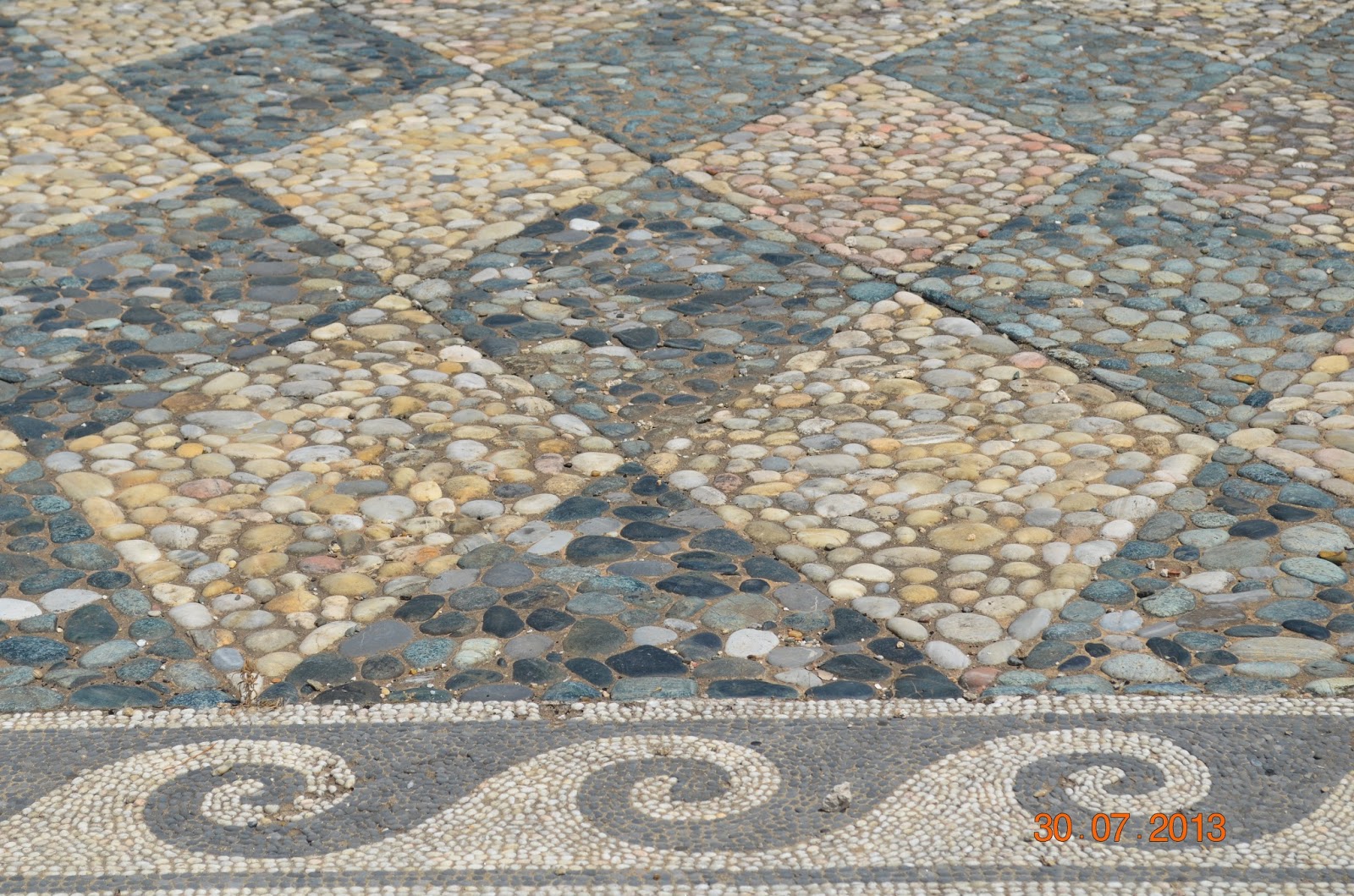
Last week we spent a day following in the footsteps of Alexander the Great in the ancient city of Pella. Located in the heart of the Macedonia region in northeast Greece, the area has been ravaged by natural disasters and time itself.  Like so many of its contemporaries, the excavation of this city, which was the birthplace of this ancient Greek hero, is a work in progress.  While parts of the site, including numerous mosaics, have been fully excavated, work was continuing in other areas.  During our visit on a blazingly hot July day, archeologists (probably unpaid college interns eager to gain hands on experience) were toiling away in the sun hoping to uncover new treasures.  Some pieces are likely to be uncovered intact while others will appear as mere fragments of their original selves, yet each is special since it is a tangible piece of the past.  We gingerly walked through the site then seeking to escape the heat, we sought shelter in the Pella Archeological Museum where previously discovered relics, including an impressive number of mosaics, were on display and protected from the elements in a well air conditioned building.  A surprisingly large number of fragile looking pieces were completely intact making me wonder how they survived the test of time while others did not.

Just a small portion of the excavated site at Pella; work was ongoing
with other areas being excavated
As I have many times before, when I stand amidst these ancient ruins that have been uncovered, excavated, and (hopefully) protected, I wonder how much of these ancient lands have yet to be (re)discovered.  The designated boundary to the protected ruins may sit mere meters away but what lays beyond the fence waiting to be uncovered?  In Pella, are treasures waiting to be discovered underneath the modern village and acres of farmland that surround it?  Are someone's farm animals unknowingly grazing on a historically significant site?  Fragments of the original roads wind their way through the Balkans towards the sea.  In places we've seen the original well worn cobblestones sitting alongside dirt and cracked asphalt.  And this is in rural areas but digs in urban areas are just as likely.  It is a common sight in Europe to come across the remnants of an ancient city, wall, or building right in the middle of a modern urban center with each infringing upon the other.  These sometimes fully intact ruins are often discovered while laying  a new road or erecting a new building.  These accidental discoveries make me wonder how much of the area has already been unknowingly destroyed.  Did a backhoe inadvertently scoop out a pile of dirt that really had historical significance?  Will we ever know if it did?  How do we preserve the past while moving forward in a modern world?  Where does the need or desire for a new road or building outweigh historical significance?  These are the questions I often ask myself.

A close up of the mosaic work; it amazes me to think that
these tiny stones are intact having withstood time for
centuries

Saturday, August 3, 2013

The Other Greece In The Other Macedonia

Graffiti
There are two Greeces and two Macedonias.  The first Greece is the aquamarine island covered one filled with small fishing villages, fresh seafood and boats carrying sun-kissed  tourists.  The other Greece is the breadbasket of the country; rural, rugged, and decidedly untouristy.  The first Macedonia is the a fore mentioned northern most region of Greece; the second Macedonia is technically the Former Yugoslav Republic of Macedonia (FYROM), an independent country north of the Greek border that is recognized by most of the world yet whose name is disputed by its southern neighbors.

While the FYROM will be the last leg on our Balkan adventure we visited the Greek Macedonia early in our trip.  We had returned to Greece again with the goal of exploring the central and eastern environs of the country.  We clambered over the hills and monasteries in Meteora before setting out for Thessaloniki and the Aegean Sea in the east.  I'm not sure what we were expecting to see along the way--perhaps the sun drenched coast and quaint fishing villages that beg tourists to visit.  Instead, our drive took us through the flat and dusty plains of central Greece.  The roads were mostly in good condition alternating between freshly rehabilitated and still under construction leaving us to rely on common sense rather than our GPS.  The land was alternately rugged and somewhat fertile with farm tractors far outnumbering private vehicles.  We drove through one small town after another with each looking more forlorn than the last.  Greece's economy has been on a downward spiral for some time and this was so apparent as we drove through kilometer after kilometer of the countryside.  Even in the middle of the week businesses appeared to be shuttered--with the exception being places selling farm equipment.   We had lunch one day in the mountain village of Edessa where the highlight of our visit was their giant waterfalls.  (Well, the highlight of Sidney's day was watching a graffiti covered train come through the station while we were eating lunch nearby).  The waterfalls were a pleasant surprise but their beauty was marred by the obvious neglect that surrounded them.  Grass and shrubs were overgrown and then there was the graffiti. Graffiti seems to be the national signage of Greece with everything from road signs and buildings to trees and even vehicles being covered with the colorful artwork (?), vandalism (?) symbols of free expression (?).  There was just graffiti everywhere.

Standing under the waterfalls of Edessa

Taking a break from exploring the Bey Hamam in Thessaloniki
And yet more graffiti
Thessaloniki, Greece's second largest city after its capitol Athens, wasn't quite what we had been expecting either.  With the city sitting on the edge of the Thermaic Gulf I had visions of crystal waters and fresh fish gracing every menu.  Instead I was disappointed to hear that because of the rampant pollution the water was neither clean nor the source of the fish on restaurant menus.  The streets were filled with people but they appeared mostly to be disenfranchised youth lounging at cafes or hanging around the waterfront.  Again, the amount of graffiti here was unbelievable. Maybe it is because I have worked in inner cities for so long but the sight of that much graffiti had me wondering about the levels of crime and personal safety of the area.

Thessaloniki is a city with a long history so we were excited to visit her most famous landmarks.  Despite the intense July heat we dutifully set out to explore the area.  The Bey Hamam didn't disappoint.  Having visited a functioning hamam in Istanbul we knew what to expect and enjoyed following Sidney through one chamber after another exploring each nook and cranny.  The Roman Agora in the heart of Thessaloniki was another surprise.  It still amazes me that in this ancient part of the world one minute you can be in the midst of the hustle and bustle of the modern city and in the next you are standing in the middle of ancient ruins.  Now that is cool.  What wasn't so cool however; were the boarded up graffiti covered store fronts that circled the ruins.  The juxtaposition between the preserved old and the neglected new was ironic.  There were other sites we had hoped to visit but upon arriving at them we found them shuttered.  (I don't think it was the day of the week we were visiting either because by the looks of the overgrown grass these sites hadn't been opened to the public for some time).  What we did find were restaurants that were open for business and knew how to treat customers right.  While none of them were full all were eager to serve us and staying away from fish, we were treated to some of the simplest but tastiest food we had eaten in a long time.  It wasn't fancy but it was served with a smile and as Sidney said, "made his tummy happy".  Now it really doesn't get much better than that.

A beautiful view of a not so clean bay

I wanted to like Thessaloniki and the Macedonia region of Greece; I really did.  It is Greece after all!  So many people had raved about the region that I was excited to visit. Perhaps I had set my expectations too high.  Or as Glenn said, after all of the traveling we have been doing in the past couple of years, it was time we experienced a dud.  I can honestly say that Thessaloniki and the Macedonia region of Greece is an area I won't be rushing back to.  Perhaps we missed out on the real treasures but I left there feeling a bit depressed and wanting a bit more.  Or perhaps I need to stick to visiting Greece's islands.  I wanted the area to be cleaner, brighter, and better cared for.   As a first time visitor I'm not sure if the conditions we saw are a direct reflection on Greece's fragile economy or if that is the way the city has always looked.  I hope it is the former since that gives me hope that it can turn around when the economy rebounds.  I do love this region's wine though, and am pretty sure I will be able to find it at home.  That will be my Thessaloniki / Macedonia / Greek souvenir.


Ancient ruins right in the middle of the city