

Wednesday, April 29, 2015


Monday, April 27, 2015
You Are What You Eat...... And Others Want To Be Us???

When we lived in Albania it often felt as though the American flag and symbols of the country were everywhere. The flag was found on clothing, waving from flagpoles that weren't associated with the U.S. Embassy or American owned businesses and generally just about everywhere you looked. American pop music from the 1980s (particularly Michael Jackson and MaDonna) seemed to be the most popular songs played in cafes. At first it felt odd but on some days it felt like a little retro piece of home. On more than one occasion while we were out and about, upon hearing our speaking English with an American accent youth would shout the words "we love Obama" and "we love America" in our direction. I'm sure they would have been saying this regardless of who was sitting in the White House. But then again, in all of my traveling with the exception of being in Albania and neighboring Kosovo, I have yet to have an exuberant love of my home country shouted out in my direction. But that doesn't mean that America's influence has escaped the rest of Europe.
Take food for example. Long before John Kerry became Secretary of State the Heinz brand was spreading their Americanism to all parts of the world. (John Kerry is married to Heinz heiress Teresa Heinz). And their condiment business is so much more than ketchup; the most peculiar topping of all is an orangey-gold colored concoction called "American sauce". I have never seen such a thing in the United States but here in Europe it is everywhere with small squeeze bottles lining grocery store shelves to gallon sized vats of it being dolloped out from frite carts. I personally never tasted the sauce but found its name slightly amusing. But when I was gifted with a bottle by a fellow American I took a closer look at it. From the ingredient list that I translated from German to English it appears to be a combination of ketchup, mustard, mayonnaise and pickle relish along the lines of a thicker Thousand Island dressing (another combination that I find less than appetizing). Looking at it with humor I guess it does sum up America's fixation with ketchup and related condiments but just the same I'll let my European friends enjoy this great American export.
But this isn't the only oddly American monikered food item found in Europe. Steak Americain or filet American is a popular menu item in many Belgian restaurants. I'm sure more than one American has sat down at the table, ordered and expected to cut into a thick steak. That isn't what they will be eating, though. Rather, Steak Americain is actually what much of the world calls steak tartare, a mound of finely chopped raw beef that more often than not (in Belgium anyway) is topped with a runny egg. I don't have the faintest idea how this dish came to have the word American tacked onto it; yes, many Americans may prefer their steaks bloody but raw is a whole other category. And I've seen other Americanized menu items as well; American pizza is dotted with chopped up hotdogs; the same goes for the omelette American. American style beers have a color so pale they look more like colored water and American chicken is oddly fried and coated in the afore mentioned ketchup. I once saw a menu where food portions were served in "petite", "normal" and "America" sizes. I kid you not.
Countries and cultures are often associated with their foods but are the above examples really what others think of America? Maybe. After all our local Carrefour has an "American" aisle filled with Hershey's syrup, Old El Paso taco kits and "American style" over stuffed Oreo cookies. And of course ketchup. Big bottles of ketchup. And it isn't just the Americans who are shopping here.
Friday, April 24, 2015
The Windmills of Kinderdijk
 Every country has at least one cultural icon that is immediately recognized as belonging to their heritage. For the Netherlands, there are several. Cheese, tulips and clogs immediately come to mind as do windmills. And although they are increasingly being replaced by modern soaring metal ones, the stout wooden buildings with thatched roofs are about as iconic as they come. You still see them dotting the canals and lowlands of the country but if you want to walk amongst them and through them, the UNESCO World Heritage site of Kinderdijk Mills is the place to visit.
Located in the southeast Alblasserwaard region of Zuid-Holland, three separate rivers meet the village of Kinderdijk. The area is marshy, flat and windswept. The convergence of the rivers in an area that is already below sea level, thus making the region susceptible to flooding. To combat the drainage issues a series dykes, a steam powered pumping station and 19 mills were erected along the banks of the rivers. Two additional pumping stations were later built and the entire pumping system switched to an electrical operation in 1924.
Much like the lighthouses of the coastal regions, these windmills were vital to the safety of the entire area. Each mill was operated by a miller who was responsible for keeping his particular mill running smoothly. Needing to be available twenty four hours a day, millers lived in the mills with their families. The quarters were by no means spacious and some larger families, including one with twelve children who resided in the Nederwaard for many years, were quite cramped. But in addition to being working mills they were also full fledge homes complete with kitchen, bedrooms and living quarters, albeit with a giant gear in their center and large blades spinning outside of their windows. And as I learned during my visit, a single mill does little on its own. Instead, the mills--in this case all 19--- worked together in unison to pump the water at whatever speed and in which ever direction was required at a moment's notice. The large blades, which almost sweep the ground as they go around but their power is unmistakable.
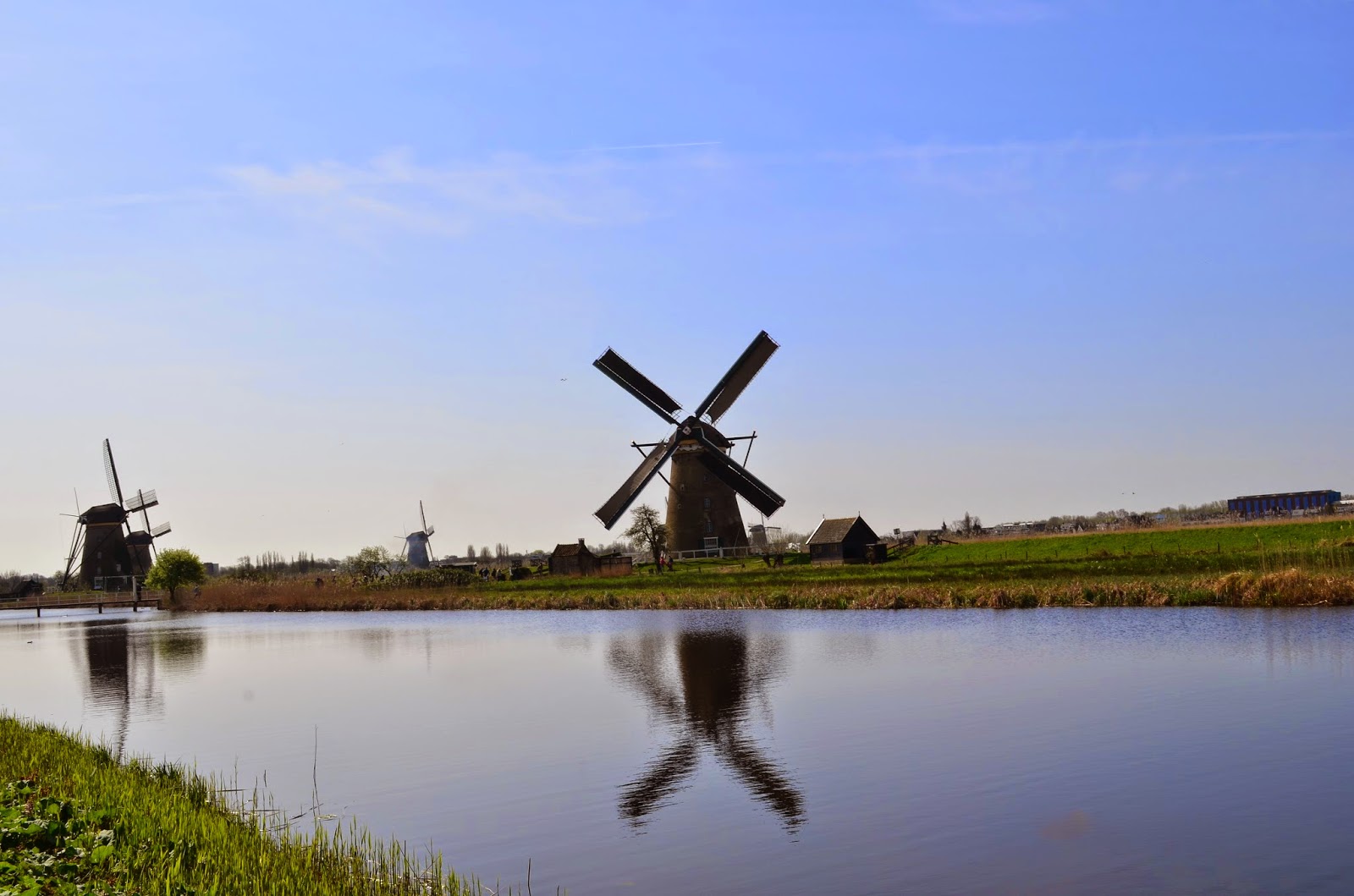
The mills joined the UNESCO World Heritage list in 1997. Today visitors can walk or bicycle along the canals and catch a glimpse of mill life. Alternatively, or in combination with, you can tour the canal via a ho-on -- hop-ff boat and view the windmills from the water. A ticket provides admission to the visitors center as well as the interiors of two windmills. At the visitors center located in the modern pumping station, a multi-screen video provides an overview of the history of the area and the building and operation of the windmills and water management. The inside of the Nederwaard mill is trapped in time and depicts the way a mill family lived in the mid 1700s. This mill was built in 1738 and here the more agile can climb up a series of steep and narrow stairs to the top of the mill, passing through a small kitchen and living area, several sleeping nooks and the gears that propel the windmill blades as you go. The second mill, Blokweer, is still occupied by a miller who explains the milling process to inquisitive visitors. In between these mills are other privately occupied mills that are meticulously maintained yet closed to the public.
It is quite amazing to walk along the canal and amongst the mills and marvel at both the power of water and the impressive Dutch approach to managing and controlling it. It is even more amazing to stand under the shadows of the turning mill blades and hear the wind whipping through their frames. Plus this entire area of the Netherlands is absolutely beautiful. So if you get a chance, go visit. You won't regret it.


If you go:
Kinderdijk Mills
Nederwaard 1
2961 AS Kinderdijk, Netherlands
Open daily from mid-February to 31 December; hours vary
Adults 7.5 Euro; ages 6-12 5.5 Euro, under 6 free
Boat tours 2.50-5 Euro
Wednesday, April 22, 2015

Tuesday, April 21, 2015
Mean Girls

It sounds a lot like tween drama or the makings of a bad made for television movie but in reality they exist in real life and even more tragically, they exist at all ages. Mean girls span the generations and can be young girls, grown women and even senior citizens. Little mean girls are often the offspring of mean mammas and mean mammas are often raising their own little mean girls in the making. You would hope that mean girls are just a passing trend but they aren't. I met my first mean girl when I was in junior high, encountered even more though high school and college and sadly have continued to encounter them throughout my adult life. Sadly enough, mean girls seem to be timeless.
As an adult woman I've seem my peers acting as mean girls and was actually "mean girled" recently by another mother. Her barbed comments followed by her actions then subsequent snubbing of me initially left me speechless. But rather than be hurt---the way I was in earlier mean girl encounters--I was more irritated. I no longer feel a need to fit in or to be accepted by the masses. I also realize that while on the outside these girls may appear to have inflated egos and senses of self esteem, the opposite is more likely the case. All of the bluster and meanness is really a facade covering up one's insecurities. When one tries too hard to fit in and be accepted, more often than not, the opposite takes place. So after watching this mother's actions from afar I can honestly say that I don't have any desire to be a part of her crowd. I don't like what I see and I don't have time for those antics. I've been there and done that years ago. Now, we are grown women who should be acting as positive role models for our children instead of acting like children ourselves. Or perpetuating the cycle of bullying and being mean girls.
Monday, April 20, 2015
Everything Is Blooming At Keukenhof Gardens

Keukenhof traces its roots back to the 15th century when Countess Jacqueline of Bavaria gathered fruits and vegetables from the gardens surrounding the area. Keukenhof Castle was built in 1641 and encompassed a total of 200 hectares but it wasn't until 1949 that the gardens became a permanent exhibition of spring flowering blooms. The gardens may only be open for a few short weeks each spring but maintaining the gardens is a year around operation. Starting each September, 30 gardeners spend three months hand planting over 7 million flower bulbs. But these aren't just any bulbs that are planted. Close to 100 suppliers provide their best bulbs to the garden each year and the garden designers work to create unique gardens and displays that best highlight the beauty of the flower. Additionally, new grass is planted each year as well to ensure the manicured perfection that guests see. And much to my surprise, once the garden closes for the season, each of the 7 million bulbs are dug up and destroyed before the planting cycle starts all over again.
So what do visitors to Keukenhof get to see during their visit? Flowers of course but there is so much more. Flowering bulbs bloom in three waves: early, middle and late. (I learned this during my visit to the gardens). The varied blooming seasons ensure that visitors will see flowers regardless of when they come to the gardens. We were there during the middle season when hyacinths seemed to be the predominant flower. I love hyacinths---particularly the purple ones--and their aroma filled the air with an unmistakable sweet fragrance. But hyacinths of all colors were everywhere. There were lots of tulips as well. Rainbow like waves, edged by perfectly green lawns, filled just about every open expanse of the garden. It was breathtaking and beautiful and as someone who can only get weeds to flourish, it left me spellbound. There are water features as well; canals, fountains and ponds complete with swimming swans lend a tranquil atmosphere even when the gardens are crowded. Portions of the gardens are shaded by towering trees and a stroll through the Japanese inspired garden provides not only shade but an array of yellow daffodils. Kids of all ages can wander through a boxwood maze to make their way up to a viewing platform where you can take in the fields of tulips surrounding the gardens. And best of all there are plenty of places to sit and take it all in. And even on a crowded day, it was easy to find a quiet spot to sit and contemplate the flowers. (And for the more energetic younger set there are two age appropriate playgrounds and a petting zoo).
 |
| Waves of flowers (and crowds) |
 |
| Shades of purple |
 |
| The many faces of Van Gogh |
Each year the gardens have their own theme and for the 2015 season that theme is honoring Vincent Van Gogh on the 125th anniversary of his death. Van Gogh may have begun his artistic career in Belgium, but he was born in the Netherlands in 1853 and spent much of his life living and working in various parts of the country. It was just beginning to bloom during our visit but the centerpiece of the Van Gogh tribute is an expansive 250 square meter bulb mosaic comprised of tulips and grape hyacinths. Making Van Gogh modern is a selfie garden that is inspired by Van Gogh's numerous self portraits. Here you can pose in reflective mirrors for your own selfie as well as have your picture taken alongside the artist. And if you're thirsty you can even get yourself a bottle of Van Gogh beer!
 |
| There's still time to see Van Gogh in bloom |
But there really is so much to see at Keukenhof so a visit is a must. If you are fast you too can catch the last weeks of the 2015 blooms. If you miss it, mark your calendars for the 2016 season. I was there in 2015 and plan to return in 2016. In the meantime inspiration has struck me and I'm trying my hand at establishing my own little flower garden. Let's hope a green thumb prevails over black.
If you go:
Keukenhof Gardens
Stationsweg 166a
AM Lisse-Holland
+31 252 465 555
www.keukenhof.nl
Daily 08.00-19.30
Open for the 2015 season: 20 March - 17 May
Open for the 2016 season: 24 March - 16 May
16 Euro adults, 8 Euro ages 4-11, under 4 Free
Parking 6 Euro
If you go:
Keukenhof Gardens
Stationsweg 166a
AM Lisse-Holland
+31 252 465 555
www.keukenhof.nl
Daily 08.00-19.30
Open for the 2015 season: 20 March - 17 May
Open for the 2016 season: 24 March - 16 May
16 Euro adults, 8 Euro ages 4-11, under 4 Free
Parking 6 Euro
Saturday, April 18, 2015
The Blooms Of Keukenhof Gardens
Nothing says spring more than brightly colored flowers and few places burst with colors the way Keukenhof Gardens does for a few weeks each spring. Here's a snippet of the beauty I experienced during my recent visit:


Subscribe to:
Posts (Atom)