

Showing posts with label Germany. Show all posts
Showing posts with label Germany. Show all posts
Wednesday, December 2, 2015


Wednesday, April 8, 2015


Wednesday, April 1, 2015

Tuesday, March 17, 2015
The Botanical Garden At The Wilhelma Zoo
 This time of year is tough weather wise. Days are more apt to be gray and dreary than they are sun filled, trees are still barren and a few select flowers may have begun to tentatively pop up from the ground. Come March I find myself in desperate need of a pick-me-up and this past weekend I found just that in Stuttgart, Germany (of all places). I spent the day at the Wilhelma Zoo and Botanical Garden and experienced the boost of spring I so desperately needed.
 |
| Prickly garden |
Visiting in March, the grounds were well manicured but lacked the vivid colors and lush foliage that summer blooms would bring. But all was not lost. By stepping inside one of the many indoor tropical glass houses, I was greeted with the warmth, humidity and lush colors that I was looking for. While I don't have a green thumb--a black thumb is more like it--I've always been a fan of greenhouses of all kinds. Whether it is the greenhouses with budding seedlings found at your local garden shop or elaborate arboretums at botanical gardens, there is something about the earthy smell and steamy humidity that just relaxes my body and my soul. And the steamy and lush glass houses at this botanical garden were no exception.
 |
| Strolling through the azaleas |
 |
| Bloom ready to burst open |
 |
| Yes, the color is real |
All of this was a wee bit of welcome paradise that was just what I needed to drive away the late winter blues. And judging but the manicured grounds and carefully pruned trees outside of the glass houses, I can only imagine how beautiful the entire grounds must be in the midst of summer. I dare say that they warrant a return trip to Stuttgart.
 |
| Lush foliage and steamy temperatures provides a brief respite from the raw weather outside |
If you go:
Wilhelma Zoo & Botanical Garden
Wilhelmaplatz 13
70376 Stuttgart, Germany
+49 711 54020
16 Euro for adults, 8 Euro children, ages 6 and under are free
Open daily from 08:15; closing times vary throughout the year
Wednesday, December 17, 2014

Thursday, November 20, 2014
The Saxon City Of Dresden
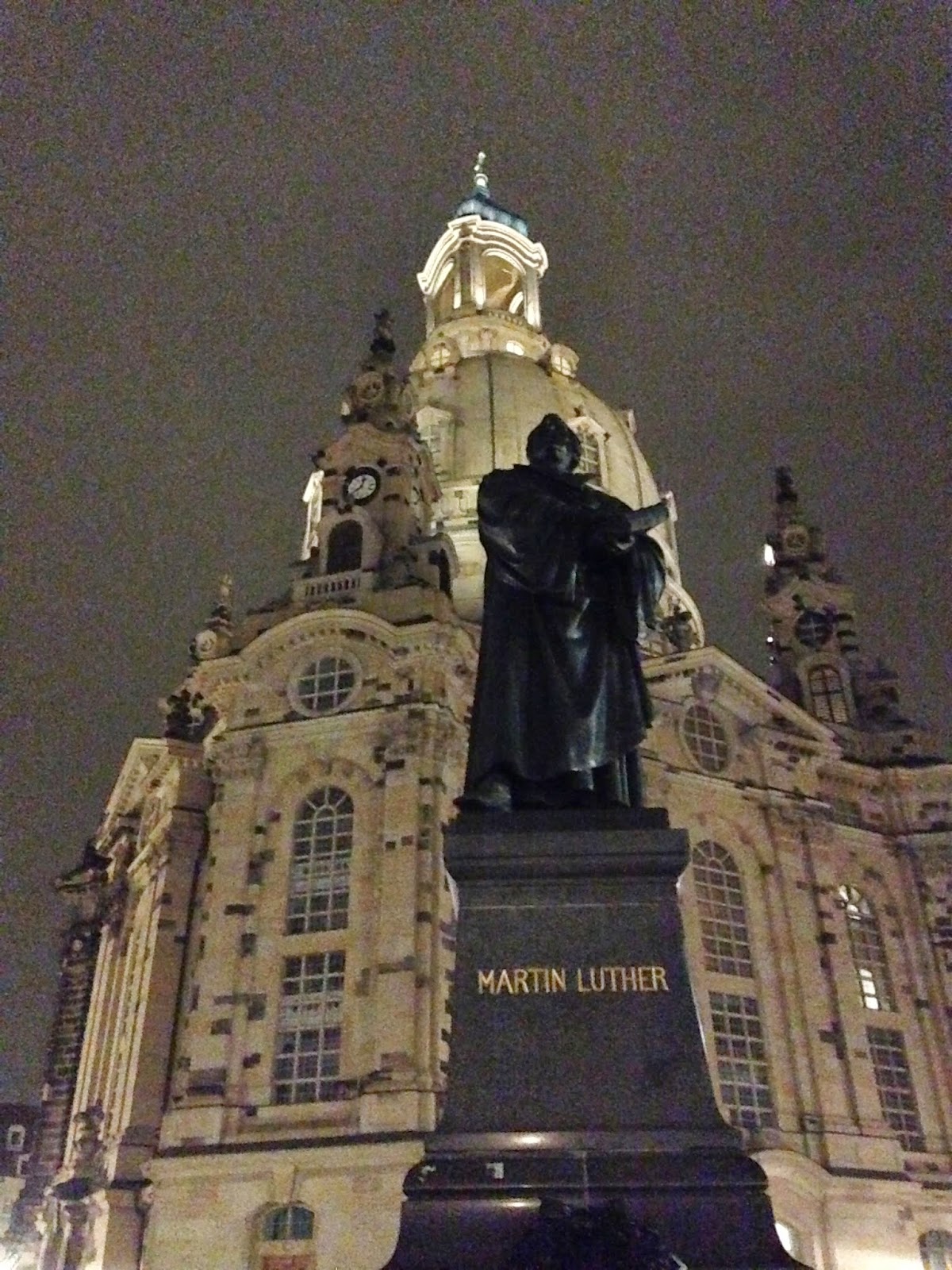 |
| Frauen Kirche at night |
Located in the Saxony region of eastern Germany near the border with the Czech Republic, Dresden has long been a cultural, educational and political center for Germany. Dresden was first settled in the 12the century, became the seat of the Saxony region in 1485 and quickly became a gathering place for painters, musicians and architects from all over Europe. This confluence of artistic talent influenced the skyline for which Dresden in famous. The 1800s saw an increase in the military presence in the area with over 20,000 military personnel serving in the garrison there at the beginning of World War I. This combination of art, culture and yes, military brought about the circumstances by which I knew about Dresden; the bombing of the city by the Allied forces.
For three days in February 1945, in a two-fold attack, the Royal Air Force and the United States Army Air Forces dropped 2,431 tons of explosive bombs and close to 1,476 tons of incendiaries on the city of Dresden. While the bombs damaged and destroyed buildings, the incendiaries ignited what was left, essentially burning the largely wooden city, therefore reducing the amount of shelters available for retreating German soldiers and refugees. Years later the number of reported deaths was 25,000 but at the time Nazi propaganda had the number in the 200,000 to 500,000 range. Because the target was not a military installation, women and children accounted for the majority of the causalities. The legitimacy of the bombardment was immediately questioned by war observers. The majority of the city center was destroyed and the heavily inhabited center of the city was all but wiped out while the industrial zones and military installations on the outskirts of the city escaped the bombings relatively untouched. At the time the Allies described the bombings as a legitimate attack on military and industrial targets. Although he was involved in the planning, British Prime Minister Winston Churchill took measures to distance himself from the attack.
 |
| The Furstenzug depicting Saxon sovereigns |
Walking around Dresden today you see evidence of the past as well as hope for the future. Many of the city's grand buildings bear the pock marks of bullets and wear the soot and grime of age with pride. Rather then fill them in or erase evidence of the destruction, they are a part of the Dresden landscape. A walk along the promenade above the Elbe River shows off the city at its best. To me, Dresden feels worn but proud with a sense of hope. Across the broad flood plain of the Elbe sits the more modern and reconstructed part of the city. Closer to the historic city center the grand buildings that house the city's museums, educational and cultural centers. Some buildings show their age while others appear to be in mint condition. Newly constructed hotels fight for space with the restaurants, cafes and trinket shops that are ubiquitous with every tourist center.
 |
| Dresden skyline |
I liked Dresden. A lot. I wish we had more time to explore her secrets but now that we have gotten a taste of what she has to offer we want to return.
Thursday, November 13, 2014
Lions & Tigers & Bears, Oh My!
 |
| Gorilla in the monkey house |
When the Berlin Zoo was first opened, it was the first zoo in Germany, the ninth in Europe and was located on the outskirts of the city limits; today it sits in its center.The first animals were donated by Frederick William IV, the King of Prussia who had a summer retreat complete with peacocks, bears, kangaroos and water buffalo on an island near Potsdam. The first full time director was appointed in 1869 and from then until the end of the century the zoo continued to grow in both size and scope as exotic animal habitats with ornate structures were established. The building of a minaret topped antelope house, and Indian style elephant house, and Egyptian inspired ostrich house and the elephant gate house soon had the Berlin Zoo competing with the venerable London Zoo.
 |
| Have you ever seen a goat actually standing on the ground? |
 |
| Penguin swimming |
It may have been cold but this zoo is great to visit any time of the year. Plan on making a day of it; we were there when the gates opened and they were shutting them behind us as we left. But the day flew by so if you are in Berlin and need a break from war history, visit the zoo. You won't be disappointed.
 |
| The sea lion show |
If you go:
Hardenbergplatz 8
10787 Berlin, Germany
+49 (0) 30 254 010
Accessible by U-Bahn & S-Bahn
www.zoo-berlin.de
Open 09.00-19.00, reduced hours during the winter
Adults 13 Euro, children over the age of 5 are 6,50 Euro; family tickets and combination tickets for the
aquarium are also available
Saturday, November 8, 2014
An East German Way Of Life

The interior of the museum itself is dark and concrete which appropriately sets the tone for what you are about to see. Kitschy is a word that can be used to describe many of the exhibits in the museum (and I say this in the best way). An ubiquitous Trabi was meant to be sat in and "driven" through the streets of East Germany. Every day life is portrayed through the model kitchen, living room and bathroom in the museum. The appliances, furniture and accessories looked remarkably similar to those in my own American grandparents home. The avocado green and gold of the 1970s? Yes, the East Germans lived with that too. And the bathroom? It wasn't American at all and could only be described as functional but it did look awfully similar to many that I encountered in 2012 Albania. (Powder blue). Sidney was especially taken with the rotary telephone. He eagerly sat on the scratchy plaid sofa and dialed and chattered into the phone. He only stared at me in disbelief when I explained to him that that type of telephone was the one I grew up with. The manuel typewriter was another novelty for a boy who is
 |
| The novel rotary telephone |
But there were obvious differences between life in the west and life in the east. The food that was available for purchase was limited, involved queueing for hours and in the end was pretty unappetizing. Essentially every aspect of life was dictated by Moscow. There were sparsely filled wardrobes displaying the "fashions" of the time. None were fashionable by any stretch of the imagination and even during a time when polyester was all the rage, these man made materials were enough to make my skin crawl. But these fashion options were deemed appropriate by Moscow so that is what was available. There was the vacation display showing happy families cavorting in the buff at the beach, playing tennis or simply lounging. The first thought that entered my mind was that such a display would be deemed pornographic and simply not be allowed in any American museum. Sidney actually spotted the display before I did. He paused, looked at it then turned and told me that all of the people were naked. His only other commentary was that it was silly to play tennis without clothes. That was that. One exhibit focused on women's reproductive health which seemed to be quite advanced for the time and in many senses was ahead of where the U.S. is today.
 |
| Gas up your Trabi, grab you atlas and hit the road through these countries |
And there are so many more things to see and explore here. Overall this museum is compact but every space is dedicated to portraying an aspect of daily life in East Germany. Our visit was interesting, I learned a few new things and it was the perfect place for younger kids to have a hands on exploring experience. And for what is a relatively low price when compared to so many museums, spending an afternoon at the DDR Museum is well worth the time and expense.
If you go:
DDR Museum
Karl-Liebknecht-Str 1
10178 Berlin-Mitte
+ 49 30 847 123 73 - 1
www.ddr-museum.de
Open daily 10.00-20.00, Saturdays until 22.00
Adult 7 Euro, Children 4 Euro
Lockers are available but bring change since they won't make it for you. There is also a restaurant on site. Eat outside overlooking the Cathedral and river if possible.
Friday, November 7, 2014
Germany, This Is Not

For us, one of the best parts about being stationed in Europe is our ability to travel. When we lived in Albania we left the country whenever we could. There, travel outside of Albania's borders was a life line. It kept us sane, reminded us about everything Europe had to offer and provided a much needed respite from the day to day hassles. Since we've been in Belgium we've still been on the go but our travels are more apt to be inside of the country rather than out. We've been exploring every nook and cranny of our new home and loving it. But sometimes, it is still good to get farther away.
We spent last week in Germany which is so close, yet in many respects so far, from our home in Belgium. As we drove across the country to Berlin and back again I took in their perfectly paved Autobahn (or the portions that were less than perfect but actively being surfaced). Belgian roads are good in some parts of the country (Flanders) and a slow work in progress in others (Wallonia). Everything seemed so neat and orderly in the cities themselves and there was clearly a buzz that you just can't find in my little corner of the world. There was an efficiency about everything; streets and attractions were labeled, while not overly warm customer service was efficient instead of the typical pursing of the lips and "raspberrying" which is common in Belgium. And when we stood on a U-Bahn platform contemplating which direction we needed to go we were approached asking if we needed assistance. And most of all, everyone we met spoke English (not that this is an important criteria for us but it certainly does make things easier). Menus, signage and conversations were all bi-lingual (if not more). It was all really nice.
And now we are back in Belgium. Things are different here and I'm noticing it more than ever before. When fellow military members find out they are being stationed in Belgium they assume they are prepared because "they were in Germany before". This really isn't the case. It is hard to quantify the differences but things are slower, less organized and simply different here. Everything takes twice as long as it should. But the best advice I was given, and what I tell people who ask, is to accept it for what it is and enjoy it. I know we are. We really do like it here; if fact we just might love it. But then again it is all relative and we are just so glad that we aren't in Albania any more.
Tuesday, November 4, 2014
Berlin: A City Divided
 |
| Remnants of and a reminder of where the Wall once stood |
 |
| Wall remnants dividing a neighborhood |
In 1961, and seemingly overnight, the Berlin Wall was erected. At midnight of 12 August, the East German police closed their border with the west and by morning roads allowing access to West Berlin had been broken up and destroyed in an attempt to stop the flow of vehicle traffic. (Trains continued to move from the west to the east and back again but they didn't stop at the eastern stations where passengers saw only armed guards as the trains passed by. These stations became known as "ghost stations").
 |
| Exploring the rebar remnants |
This week marks the 25th anniversary of the fall of the Wall. With the falling of the wall life once again changed but it didn't instantly revert back to the way life had been before its construction. Remnants of the wall remained, and still remain today, and the scars of the past are ever present. You can see them in dedicated memorials, kitschy tourist traps and redeveloping neighborhoods. To commemorate the anniversary of the Wall's falling, a recent Washington Post article examined the realities of a today's Germany. Although there is no longer a physical barrier separating the east from the west, the country remains divided in so many ways. I read the article while sitting in my Berlin hotel room after spending the day traipsing through the city. With the images and history of a divided Berlin so fresh in my mind the article had a whole different meaning for me. It reminded me that while the Wall went up quickly its coming down is taking, and will take, generations for people to fully recover from. History is powerful and Berlin is a city where recent history is alive and on full display for all to see. After all, those of us who forget where we came from are destined to repeat the mistakes of the past.
 |
| A photograph of a photograph of what was known as "Checkpoint Charlie" Today it is one of the worst touristy photo gimmicks I've ever seen-- A prime example of a capitalist society |
Monday, November 3, 2014
The Wall
I remember sitting in front of our television and watching the fall of the Berlin Wall. I was in high school at the time and I distinctly remember thinking that I was watching history being made and understood that what was happening was significant. Since that day twenty-five years ago I've studied history and have come to understand just how significant that act really was. But walking along the wall in Berlin brought the significance to a whole other level.
I'll write more about the history of the wall in a future post, but in the meantime here are some pictures I took as I walked along the East Side Gallery in Berlin and experienced the power of the Wall for myself. The artwork is more expressive than words could ever be yet my pictures can't capture the feeling of experiencing it in person.


I'll write more about the history of the wall in a future post, but in the meantime here are some pictures I took as I walked along the East Side Gallery in Berlin and experienced the power of the Wall for myself. The artwork is more expressive than words could ever be yet my pictures can't capture the feeling of experiencing it in person.
Tuesday, October 28, 2014


Wednesday, March 12, 2014

Wednesday, February 26, 2014

Wednesday, February 19, 2014

Wednesday, February 5, 2014

Monday, February 3, 2014
Its A Small, Small World
 |
| The American interstate system (in miniature) |
Housed in a renovated 1,300 square meter warehouse on a canal, this museum is a fantasy world for big kids and little kids alike; a place where no detail is too small. The three museum floors bring eight distinct communities and countries to life in miniature form moving from day to night-complete with dawn and dusk- every fifteen minutes. I felt as though we were giants as we wandered from the Swiss Alps to Austria and Germany to Scandinavia and back again taking in the most minute of details. Whether it be trains, buses or airplanes, all modes of transportation were fitted with tiny passengers toting even smaller pieces of luggage. And speaking of airplanes, the Knuffingen Airport includes planes landing and taking off (with sound effects of course), baggage carts and trams whizzing around the tarmac, and a parking garage complete with traffic jams. It was virtually impossible to pull Sidney (and Glenn) away from the airport but the enticement of more trains winding through the Alps, complete with snow capped mountains, hang gliders, and avalanches did the trick. In Scandinavia we saw a cruise ship navigating the fjords and a busy commercial port filled with barges and container ships all floating atop real water. In Germany we saw modern cities complete with lights and traffic jams as well as snow rural hamlets with grazing livestock.
And then we had America. It is always interesting to see what American stereotypes Europeans use to portray my motherland. And the stereotypes were all there. Naturally there was the Florida exhibit complete with palm trees and a space shuttle that launched every few minutes. And what American scene would be complete without throwing in a big of Vegas? Yes, Las Vegas was recreated in miniature form right down to the flashy casinos, Elvis impersonators, scantily clad dancers, and the neon filled Strip. Rounding out the American scene were the red rocks of the American southwest with a winding interstate snaking its way through the cliffs. A close look at the red rocks revealed ancient Hopi settlements, cowboys astride horses, and even a pioneer wagon. Yes, the creators took some historical liberties and blurred the centuries with the depiction of America but it was impressive none the less.
For me, the best part of each montage was finding the hidden bits of whimsy. It actually became a challenge to find them all. On a mountainside slope a woodsman used an axe to chop persistently at a tree until it fell. A naked couple frolicked in a field of sunflowers in another scene while a scuba diver was attacked by a crab in a Scandinavian harbor. Traffic clogged bridges and firefighters rushed to douse the flames in a burning building. Each urban montage seemed to include at least one traffic accident complete with ambulances, police officers, and tow trucks. These are just a few of the details that could be missed if you didn't look carefully. And despite all of the time we spent there, I know we missed numerous other details. The hotel concierge was right when he told us that we could get lost in the museum for hours. (Or as he said, I hope you don't have any appointments for the rest of the day).
 |
| Scandinavia, complete with real water |
 |
| The parking garage and tower of the Knuffingen Airport |
 |
| Trains meandering through the Swiss Alps |
Subscribe to:
Posts (Atom)