Showing posts with label Albanian life. Show all posts

Sunday, April 14, 2013

Caution: Road Construction Ahead

The warning-- a few mere meters before
the end of the road
Although severely lagging behind the rest of Europe, Albania's roadway system is exploding and expanding by leaps and bounds.  Roads are appearing where none had been before while once dirt tracks are being widened, groomed, and then paved.  We've noticed the expansion and improvements in the two years we've been here; travel times between cities have been reduced and while it still happens too often, encountering "sudden loss of asphalt" syndrome is less frequent than it used to be.  However, road construction in Albania is unlike anything else I've ever seen before.  Perhaps there is a system that notifies people that we are just unaware of but more likely you are just supposed to be careful and be prepared for the unexpected.  After all, that seems to be the motto when traveling any Albanian road. Rarely is impending work marked with signs warnings of construction zones ahead.  And even the largest of projects are conducted in small bits and pieces.  A section of road might be widened and paved with the next kilometer or so being skipped over before improvements continuing a short distance later (hence the "sudden loss of pavement" syndrome).  Work around bridges tends to be particularly bad.  I've seen entire stretches of road repaved only to have the bridges left untouched meaning traffic must detour down and around the span the bridge is supposed to go over.  Construction also seems to happen seven days a week with the majority of the work actually being conducted on weekends.  In an only in Albanian way, this makes sense since there is less traffic on weekends.  This is especially important since roads and construction zones are not closed to traffic while work is taking place.  I regularly see cars and furgons whizzing around backhoes and bulldozers, around men working with pick axes, and yes, speeding over and around freshly laid asphalt.  (This is likely one of the causes for "new" roads falling apart and becoming riddled with pot holes shortly after work is completed).  In the United States it would be unheard of to allow vehicles, people, animals, or any unauthorized entity to enter into a work zone.  Just think of the lawsuits that would ensue if something went wrong.  No such worries in Albania, a country where you are ultimately responsible for your own destiny.  Fixing the smallest pot hole in America requires miles of road in either direction to be blocked off and guarded by police.   In Albania, this is unheard of.  Hence, the scene we drove into yesterday.
Road block

We were out doing some out of the city exploring on a section of unpaved road, part of which we had driven on a few weeks ago.  This road, while narrow and rutted with pot holes and boulders is considered to be an important main through fare here.  Nothing seemed out of the ordinary until we rounded a curve and noticed a man working sign sitting next to a traffic cone. Both are rare enough occurrences that should have given us pause but we merely commented on it and continued up the hill.  Until we couldn't any go any further.  At the crest of the hill sat a backhoe, a dump truck loaded with gravel, a handful of construction workers, a couple of old men and young boys observing and a huge hole in the road.   Apparently we had entered into a work zone with a dug up road that wouldn't allow us to continue.  One of the workers waved his arms and made some hand gestures but we couldn't figure out what was happening. Then a large work truck appeared in our rear view mirror and because we were in his way, came to a stop and began honking their horn.  Soon a man got out of the truck approached us and entered into a stilted conversation with Glenn in Albanian.  He spoke with the construction workers before returning to our vehicle and informing us that they were working on the road and it would be closed for one hour.

As Glenn and I pondered what was really going on and wondered whether we should turn around and backtrack for three hours, we watched in horror as the truck behind us backed up, drove off the side of the road and attempted to maneuver around the construction site.  As the driver attempted to move up a steep and rocky, yet muddy hill we watched the truck lurch and spin its wheels before sliding back down the hill. He tried again and again with each attempt looking more precarious. At one point the truck lurched to the right and appeared to be on the verge of tipping over.  I had seen a small child sitting unprotected in the passenger seat of the truck and my heart was in my throat as I feared what would happen next.  Perhaps it was that Mediterranean machismo that caused the driver to continue his quest but finally he came to his senses, slid back down the hill and returned to his position behind us.

By this point Glenn had also gotten out of the vehicle and gone up to investigate the construction site.  Apparently a new concrete culvert was being laid in seven separate sections in preparation for the entire road being paved within the next two years. The foreman of the group assured Glenn that it would be complete in five minutes and we would then be able to continue on our way.  I was skeptical when I heard this but then again what do I know about Albanian construction.  The occupants of the truck were now standing beside our vehicle engaging Glenn in a halted conversation. I listened but due to the fact I was a female was of little consequence to the men.  They asked Glenn a series of questions starting with whether or not we were Albanian (do we look Albanian?), where we lived, and once they found out we were associated with the U.S. Embassy, they inquired as to how much money Glenn makes a year.  You have got to love the Albanian lack of boundaries that would have them thinking this was an appropriate question to ask. Things got even stranger as they started oohing and aahing about our old Nissan asking where we bought it, where it was made, and yes, how much we paid for it.  They stared at amazement at our camera as Glenn took pictures of the scenery around us. (He was also documenting this scene since it is one of those things that without pictures, no one would believe). Then much to my surprise, and Sidney's too, one of the men opened the rear door so his son (the poor a fore mentioned boy) could see Sidney.  No asking permission, just doing it. That seemed a bit ballsy even by Albanian standards.  Sidney, who had just woken up from a nap stared at him stonily and silently until he closed the door.
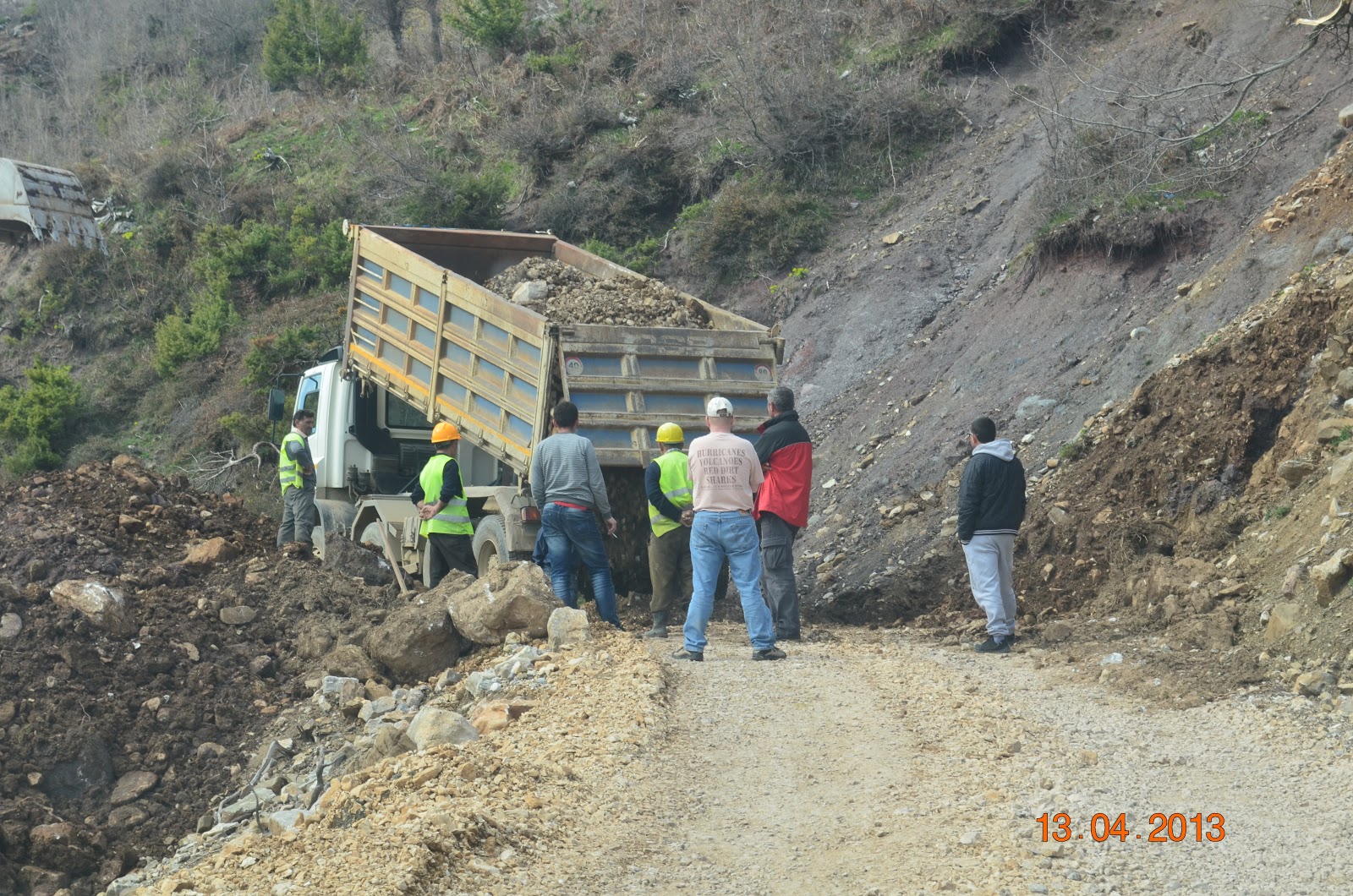
How many men does it take to watch a hole being filled?

The promised five minutes crept closer to the one hour that the truck driver had predicted.  By now we were joined by a third vehicle whose driver also honked his horn for us to get out of his way.  Like we were all hanging out in the middle of the road for the fun of it.  Finally the last piece of concrete culvert was laid, two men popped out of the ditch and the filling in of the road began.  Sidney counted ten hods full of earth being dumped on top of the culvert.  Then the waiting dump truck emptied his load before speeding away and the backhoe went to work with tamping the earth into place.  Finally we were beckoned to be the first ones to drive on through. I was apprehensive as to whether the road would hold but it did and we were once again on our merry way.

As we continued down the mountain and through the valley we saw evidence of other culverts having been laid.  None of this work had even been started two weeks earlier but now it seemed as though construction was moving ahead at full steam.  Around each and every corner we encountered small groups of men working.  Some were pouring concrete while others were digging ditches or filling holes.  We saw a retaining wall made of intricately placed stones being built by hand.  There was always at least one elderly man wearing a sports coat observing.  Sometime there was also a child or two as well as the predictable donkey and dog.  The Albanian roadway system is definitely expanding.  We witnessed this first hand. In fact, we were almost a part of this new road.

Saturday, January 5, 2013

Brakes Are Optional

Yesterday on Facebook a friend posted her frustration with the impatience of Boston drivers and their liberal use of the car horns.  I read the comment and chuckled since I had been thinking the same thing about Albanian drivers during my own short, but anxiety laden drive between my house and the grocery store.  We had been warned about Albanian driving habits before we arrived in the country and were briefed on the dangers of driving in Albania on our very first day at the Embassy.  Some joke that driving is a contact sport in Albania. While most days I wouldn't go quite that far (although I have experienced my share of bumps and dings while driving) driving here certainly isn't for the faint of heart.

The first thing one notices about Albanian drivers is that they only use their brakes as a last resort.  Blinkers and horns are used to an excess but Albanian drivers will swerve around slower vehicles, pedestrians or stray animals rather than use their brakes to slow down.  If you are like me and are foolish enough to stop for a red light (when the lights are working) or a stop sign, cars will come barreling up behind you, swerve to either the left or right (if you are lucky) and continue right on down the road.  I've had more near misses than I can count as both a pedestrian and a driver because I've assumed that on coming vehicles will stop for the traffic signals.  And don't even get me started about driving through the numerous traffic circles that clog Albania's roadways.  Cars pummel into them at full speed crossing from left to right and back again with nary a brake light in sight.  It continually surprises me that I haven't seen more accidents.  The aforementioned bumps and dings on the other hand, are another story.

When Albanian drivers see an open space--whether it be a left turn lane and they are continuing straight or turning right or the empty space is the lane for on coming traffic, they drive in it.  I'm not just talking about the mopeds and scooters whose drivers seem to have a completely different understanding of traffic laws.  (Personally, if I was driving such a small vehicle with no helmet or protective gear I would be especially careful and observant).  Furgons, trucks, and even buses join the ranks of sedans in creating three and four lane roads out of single lane streets.  On a street such as Tirana's main boulevard which already has numerous lanes, more often than not it will become a free for all of cars speeding in all directions in all lanes.  If a car has actually stopped to turn across oncoming traffic, it is a common sight to see two, three, or more other vehicles who have driven up around or in front of the vehicle in order to make the same turn.  Or a car will pull up on the left then continue straight on through the intersection and down the road--again with no brake lights.  The most common sight on the road is a vehicle heading straight towards you in "chicken" mode honking their horn to tell you to get out of their way.  Since we've been here a few "designated" bicycle lanes have popped up throughout the city.  I don't think I've ever seen an actual bicycle in any of them; rather, the bicycle lane is an additional lane for motorized vehicles whose drivers don't feel the need to wait in the traffic jam with the rest of us.  The country's numerous driving schools must teach all drivers that if there is an open space, they need to drive in it.

Just as Albanian drivers don't slow down for traffic signals, they don't slow down or stop for police officers.  I can't imagine any other place where police and other law enforcement officials are so disrespected and flat out ignored as they are on Albanian roadways.  Never mind if emergency vehicles with their lights flashing are approaching; your typical Albanian driver will continue on through either oblivious to or uncaring of the rules of the road that the rest of the world observes.  On a daily basis cars continue to speed by the police officers who stand in road in front of the Embassy as they attempt to direct traffic.  This morning we witnessed this disrespect again first hand as a driver got into a verbal altercation with a police officer who had the gaul to call him out on the fact he had cut off the police vehicle and nearly caused an accident.  (We were directly behind this incident and in the end I can only surmise that the driver "won" since after a lot of hand gestures and yelling he eventually sped away with the police officer following at a slower speed).  I can only imagine how different this scene would have been in any other western or civilized country.

Whether you call it defensive driving or just pure carelessness, you are taking your life into your own hands every time you take to an Albanian roadway.  Glenn says driving in Albania is liberating.  In some ways it is but the fact remains that getting behind the wheel here scares the living day lights out of me.  I  still do it though.  I use my horn more liberally than I could have ever imagined I would and I have become more relaxed about dings and bumps.  I haven't gone totally native though; I still stop for all red lights and stop signs and when I encounter the neighborhood cows in the street, I come to a full stop and allow them to pass.