Showing posts with label Netherlands. Show all posts

Friday, April 24, 2015

The Windmills of Kinderdijk


Every country has at least one cultural icon that is immediately recognized as belonging to their heritage. For the Netherlands, there are several. Cheese, tulips and clogs immediately come to mind as do windmills. And although they are increasingly being replaced by modern soaring metal ones, the stout wooden buildings with thatched roofs are about as iconic as they come. You still see them dotting the canals and lowlands of the country but if you want to walk amongst them and through them, the UNESCO World Heritage site of Kinderdijk Mills is the place to visit.

Located in the southeast Alblasserwaard region of Zuid-Holland, three separate rivers meet the village of Kinderdijk. The area is marshy, flat and windswept. The convergence of the rivers in an area that is already below sea level, thus making the region susceptible to flooding. To combat the drainage issues a series dykes, a steam powered pumping station and 19 mills were erected along the banks of the rivers. Two additional pumping stations were later built and the entire pumping system switched to an electrical operation in 1924.

Much like the lighthouses of the coastal regions, these windmills were vital to the safety of the entire area. Each mill was operated by a miller who was responsible for keeping his particular mill running smoothly. Needing to be available twenty four hours a day, millers lived in the mills with their families. The quarters were by no means spacious and some larger families, including one with twelve children who resided in the Nederwaard for many years, were quite cramped. But in addition to being working mills they were also full fledge homes complete with kitchen, bedrooms and living quarters, albeit with a giant gear in their center and large blades spinning outside of their windows. And as I learned during my visit, a single mill does little on its own. Instead, the mills--in this case all 19--- worked together in unison to pump the water at whatever speed and in which ever direction was required at a moment's notice. The large blades, which almost sweep the ground as they go around but their power is unmistakable.
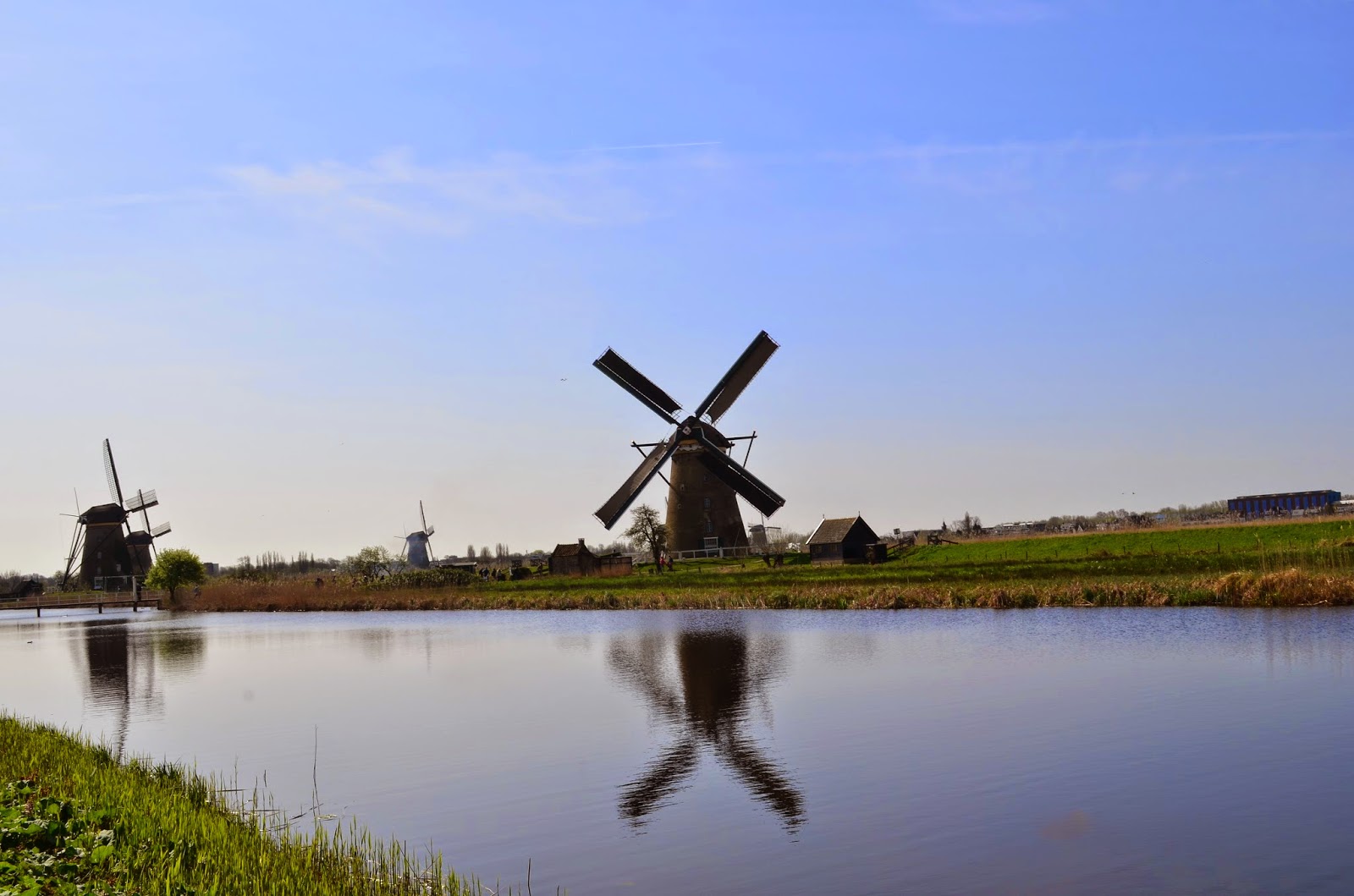


The mills joined the UNESCO World Heritage list in 1997. Today visitors can walk or bicycle along the canals and catch a glimpse of mill life. Alternatively, or in combination with, you can tour the canal via a ho-on -- hop-ff boat and view the windmills from the water. A ticket provides admission to the visitors center as well as the interiors of two windmills. At the visitors center located in the modern pumping station, a multi-screen video provides an overview of the history of the area and the building and operation of the windmills and water management. The inside of the Nederwaard mill is trapped in time and depicts the way a mill family lived in the mid 1700s. This mill was built in 1738 and here the more agile can climb up a series of steep and narrow stairs to the top of the mill, passing through a small kitchen and living area, several sleeping nooks and the gears that propel the windmill blades as you go. The second mill, Blokweer, is still occupied by a miller who explains the milling process to inquisitive visitors. In between these mills are other privately occupied mills that are meticulously maintained yet closed to the public.

It is quite amazing to walk along the canal and amongst the mills and marvel at both the power of water and the impressive Dutch approach to managing and controlling it. It is even more amazing to stand under the shadows of the turning mill blades and hear the wind whipping through their frames. Plus this entire area of the Netherlands is absolutely beautiful. So if you get a chance, go visit. You won't regret it.


If you go:

Kinderdijk Mills
Nederwaard 1
2961 AS Kinderdijk, Netherlands
Open daily from mid-February to 31 December; hours vary
Adults 7.5 Euro; ages 6-12 5.5 Euro, under 6 free
Boat tours 2.50-5 Euro


Monday, April 20, 2015

Everything Is Blooming At Keukenhof Gardens

My last post provided a peek of the flowers at Keukenhof Gardens. But no matter how good the pictures, they simply can't do justice to the acres upon acres of intricately planted blooming gardens, meticulously manicured lawns and whimsical displays that are Keukenhof. And it is their beauty that draws millions of visitors for eight short weeks each spring.

Keukenhof traces its roots back to the 15th century when Countess Jacqueline of Bavaria gathered fruits and vegetables from the gardens surrounding the area. Keukenhof Castle was built in 1641 and encompassed a total of 200 hectares but it wasn't until 1949 that the gardens became a permanent exhibition of spring flowering blooms. The gardens may only be open for a few short weeks each spring but maintaining the gardens is a year around operation. Starting each September, 30 gardeners spend three months hand planting over 7 million flower bulbs. But these aren't just any bulbs that are planted. Close to 100 suppliers provide their best bulbs to the garden each year and the garden designers work to create unique gardens and displays that best highlight the beauty of the flower. Additionally, new grass is planted each year as well to ensure the manicured perfection that guests see. And much to my surprise, once the garden closes for the season, each of the 7 million bulbs are dug up and destroyed before the planting cycle starts all over again.

So what do visitors to Keukenhof get to see during their visit? Flowers of course but there is so much more. Flowering bulbs bloom in three waves: early, middle and late. (I learned this during my visit to the gardens). The varied blooming seasons ensure that visitors will see flowers regardless of when they come to the gardens. We were there during the middle season when hyacinths seemed to be the predominant flower. I love hyacinths---particularly the purple ones--and their aroma filled the air with an unmistakable sweet fragrance. But hyacinths of all colors were everywhere. There were lots of tulips as well. Rainbow like waves, edged by perfectly green lawns, filled just about every open expanse of the garden. It was breathtaking and beautiful and as someone who can only get weeds to flourish, it left me spellbound. There are water features as well; canals, fountains and ponds complete with swimming swans lend a tranquil atmosphere even when the gardens are crowded. Portions of the gardens are shaded by towering trees and a stroll through the Japanese inspired garden provides not only shade but an array of yellow daffodils. Kids of all ages can wander through a boxwood maze to make their way up to a viewing platform where you can take in the fields of tulips surrounding the gardens. And best of all there are plenty of places to sit and take it all in. And even on a crowded day, it was easy to find a quiet spot to sit and contemplate the flowers. (And for the more energetic younger set there are two age appropriate playgrounds and a petting zoo).

Waves of flowers (and crowds)

Shades of purple
In addition to the seemingly endless color filled gardens, there are indoor pavilions hosting revolving flower shows ranging from orchids, lilies and gerbera daisies to anthuriums, roses and daffodils. Each week features different flowers so you can visit more than once, seeing new flowers each time. My favorite area, however, was the inspirational gardens paying homage to the canals of Amsterdam. This year's gardens recreated the tiny patio, rooftop or canal side gardens that fill Amsterdam's residential neighborhoods. At Keukenhof, we could pull up chairs and sit along the canal amongst potted plants, climb up to the rooftops to enjoy the flowers and the views or pop into makeshift patios and guest cottages that were beautifully adorned with flowering plants. To me, these miniature gardens with their window boxes, potted plants and beautifully painted accessories truly were inspirations making me want to go home and recreate my own little piece of heaven in my garden.
The many faces of Van Gogh

Each year the gardens have their own theme and for the 2015 season that theme is honoring Vincent Van Gogh on the 125th anniversary of his death. Van Gogh may have begun his artistic career in Belgium, but he was born in the Netherlands in 1853 and spent much of his life living and working in various parts of the country. It was just beginning to bloom during our visit but the centerpiece of the Van Gogh tribute is an expansive 250 square meter bulb mosaic comprised of tulips and grape hyacinths. Making Van Gogh modern is a selfie garden that is inspired by Van Gogh's numerous self portraits. Here you can pose in reflective mirrors for your own selfie as well as have your picture taken alongside the artist. And if you're thirsty you can even get yourself a bottle of Van Gogh beer!


There's still time to see Van Gogh in bloom

But there really is so much to see at Keukenhof so a visit is a must. If you are fast you too can catch the last weeks of the 2015 blooms. If you miss it, mark your calendars for the 2016 season. I was there in 2015 and plan to return in 2016. In the meantime inspiration has struck me and I'm trying my hand at establishing my own little flower garden. Let's hope a green thumb prevails over black.


If you go:

Keukenhof Gardens
Stationsweg 166a
AM Lisse-Holland
+31 252 465 555
www.keukenhof.nl

Daily 08.00-19.30
Open for the 2015 season: 20 March - 17 May
Open for the 2016 season:  24 March - 16 May
16 Euro adults, 8 Euro ages 4-11, under 4 Free
Parking 6 Euro

Saturday, April 18, 2015

The Blooms Of Keukenhof Gardens

Nothing says spring more than brightly colored flowers and few places burst with colors the way Keukenhof Gardens does for a few weeks each spring. Here's a snippet of the beauty I experienced during my recent visit:


Saturday, October 25, 2014

The Story Of Corrie Ten Boom

The story of Anne Frank is perhaps the best known and well documented personal narrative of the horrors inflicted upon Jewish families during the Holocaust. But unfortunately, these conditions were a reality for tens of thousands of Jewish families throughout Europe. During the first part of the 1940s, as millions of Jews were being rounded up by the Gestapo and marched away to concentration camps, other families were putting themselves at risk by hiding the persecuted within their homes. Whether they did it out of principle, religious conviction or moral obligation, their brave actions saved the lives of thousands of innocent people who would have otherwise perished in Germany's death chambers. One such family who risked everything, and made the ultimate sacrifice for their actions, was the Ten Boom family of Haarlem, The Netherlands.

The Ten Booms were a devout Christian family who earned their living at their clock and watch shop while actively pursuing and contributing to social causes in Haarlem in the century leading up to World War II. Even before the War their house served as a refuge of sorts for anyone who was in need of assistance. As the Gestapo began rounding up Jews, the Ten Booms provided them, along with students who refused to cooperate with the enemy and members of the Dutch underground resistance movement, temporary shelter until they could be smuggled out of Haarlem to safer areas. They knew their actions were placing them in danger but standing by their convictions, they continued to provide a place of refuge to those in need until they were betrayed and taken to the Ravensbruck concentration camp in northern Germany. Corrie survived her ordeal but her 84 year old father and sisters did not. In the thirty-two years following her release from the prison Corrie travelled to sixty-four countries spreading the word of her Christian faith. Her family home above the clock shop was turned into a museum that continues to serve as an open house for visitors who wish to come and learn more about her family's beliefs and brave actions.

Today no visit to Haarlem would be complete without visiting the Corrie Ten Boom House. It is easy to miss since it is tucked away on along a narrow street. A jewelry and clock shop sits on the first floor the same way it did when the ten Boom family resided here. The building is actually two houses that have been cobbled together into one with a ship's mast serving as an anchor. You would never know this by looking at it from the outside, thus making it the perfect place for hidden nooks, hallways and rooms. On the day of my visit the English speaking guide led us up a narrow set of stairs and into what had been the family's front parlor. Sitting amongst the original piano and walls lined with family portraits, she relayed the story of the Ten Booms to us. Their story is so moving and made more so as I was able to gaze at portraits of the actual house residents while she spoke. Later in tour we were lead up more narrow stairs and into the hiding room, a space built behind Corrie's bedroom where people took refuge when the Gestapo came calling. I was able to climb through the wall and into the narrow hiding space that sheltered people for hours on end. I can only imagine how dark and stifling it must have been but the alternative was simply unthinkable. I've walked and stood in a lot of history since we moved to Europe but standing in the very place where lives were saved was truly a moving experience and one that shouldn't be missed.

If you go:

Corrie Ten Boom House
Barteljorisstraat 19, 2011 RA Haarlem
The Netherlands
 0031 (0) 23 5310 823
info@corrietenboom.com
www.corrietenboom.com

Open Tuesday-Saturday from 10:00 to 15.30
Closed on Dutch holidays
Tours are free but donations are gladly accepted

Friday, September 12, 2014

Say Yes To The Cheese

Cheese anyone?
There is certainly no shortage of good cheese in Europe. Whether it be made from cow, sheep or goat milk it seems as though each region of Europe specializes in their own variety of cheese. Now I've always loved cheese and have been having a great time exploring the different varieties I encounter during my travels.  I'm particularly fond of sheep and goats milk cheeses (which taste so different than the ones I'm used to in the United States) as well as the numerous raw milk varieties that are readily available in the markets. So because of this love of cheese, when I had the opportunity to visit the Alkmaar Cheese Market in the Netherlands I jumped at the chance.

This cheese market located in northern Netherlands traces its roots back to 1593. However, as early as 1365, Alkmaar had a set of cheese scales that were used in the weighing and selling of cheese. Every cheese producing region has their "secrets" that make their cheese the best. In Alkmaar, the secret to the Beemster cooperative cheese that is sold at the market is their polder, or system of dykes and windmills that create fertile and nutrient rich grass from which their cows graze. (The design of the polder was added to the list of UNESCO World Heritage Sites in 1999). Here's a fun fact: according to Beemster, one cow requires 50 kilograms of grass and 125 liters of water in order to produce the 30 liters of milk that in turn make 3 kilograms of cheese. That means it takes a lot of cows, grass, water and milk in order to make the cheese that is sold at the weekly cheese market.

Today the cheese market operates from early April through early September on the Waagplein, the same central square where it has been taking place for centuries. While the ceremony plays to visitors (the Dutch production is translated into English, French and German), the rituals themselves are as old as the cheese market and are a spectacle to behold. Only members of the cheese guild can trade at the market. The Cheese Father, who is the head of the four forwarding cheese companies that trade at the market, leads the ceremony and ensures that the rituals are followed.

Prior to the arrival of the crowds, the cheese begins to arrive by truck and yes, even boat. Then the cheese setters or kaaszetters get to work, offloading the cheese onto the square. With the ringing of the bell at 10.00 sharp, the market opens with a flurry of activity as cheese testers and traders dressed in plush robes examine the quality of the cheese on both the inside and outside. The texture and appearance of the cheese, the number of holes and their distribution on the inside all contribute to the overall quality of the cheese and influence the price the cheese will garner. Haggling ensues until a price per kilogram is agreed upon. Spectators will know when a deal has been reached since they will see the clapping of hands which seals the deal. The cheese is then carried off in wooden wagons to the Waag where it is weighed. Finally, white dressed cheese carriers tote the sold cheese on wooden barrows to the waiting trucks. The sight of these men is impressive as is their feat; eight wheels of Gouda cheese, each weighing 13.5 kilograms, are loaded on the 25 kilogram barrow and balanced between their two sets of shoulders. Being a cheese carrier certainly isn't for the weak.

Cheese heading to market

Sharply at 10.00 the market opens


The cheese market in action

So grab your camera, wear comfortable shoes and go early to get a good spot. Everything in Alkmaar is cheese related and you will be able to buy cheese at just about every shop and mobile vendor. For the best deal, however, buy one of the grab bags of cheese that are sold by the cheese girls are the market. You are never sure what you are going to get but for 10 Euros I received four good sized chunks of cheese as well as a linen tea towel.

If you go:
Waagplein
Alkmaar, The Netherlands
Fridays from early April through early September from 10.00-12.30
http://www.kaasmarkt.nl
Free