Can you rewrite history? Apparently in Colorado they are going to give it their best shot. In Golden, Colorado the school board is taking issue with the College Board's revision of the United States History Advanced Placement (AP) curriculum. Conservatives in this Denver suburb claim that the new curriculum paints America's history is a darker and more negative light than before and therefore doesn't highlight America's "exceptionalism". According to one school board member, a new subcommittee is being set up to assure that history courses taught in this solidly middle class suburb "present positive aspects of the United States and its heritage and promote citizenship, patriotism, essentials and benefits of the free enterprise system". She further noted that "materials should not encourage or condone civil disorder or social strife". (The complete Washington Post article can be found here). Um...because America was founded on the principles of love and peace, right?
But Colorado isn't the only state that is looking at the way our country's history is being taught. Texas is already on record for opposing the teaching of the new AP curriculum in their schools and South Carolina and Tennessee are contemplating following suit. Opponents of the new curriculum claim it teaches a revisionist history of our country and one mother, a college history major herself, opposes the curriculum on the grounds that it was reviewed and approved by college history professors who "by and large, are on the left". The recurring theme that opponents keep returning to is the fact that students are not being taught about their "exceptionalism". Their message seems to be that if students aren't taught that they and their country are great, then they aren't learning the important parts of their history. I have so many thoughts on this.... Perhaps students should be able to infer this for themselves rather than being told. And greatness is all in a perspective; what made one act seem great was undoubtedly at the expense of someone or something else. Does it benefit someone from a Native American heritage to sit in a class and be told that his people were "bad" while the white settlers were "good". And then there is the phrase of "exceptionalism" itself. That seems to be the catch phrase that is applied to a whole generation of children yet if everyone is branded as exceptional, what does that really mean?
On the other side of the argument are many students and educators who will be affected by the changes. They are taking to the streets and protesting the school board's actions---thus creating the civil unrest the board so wants to stifle. And then there is the American Historical Association who endorses the new curriculum for the very challenging students and teaching them a broader perspective of our history. James Grossman, chief executive of the association says it best with teaching history is a choice "between a more comfortable national history and a more unsettling one. There's always pressure to use history to unite a people, to create a comfortable sense of yourselves." We all do it. Really, it is so much nicer to be in our comfort zone and feel good about ourselves, our personal stories and our history. But it this reality?
I was an American history major in college. I attended an elite, undoubtedly liberal, East Coast college where I shared classroom space with women from all socio-economic and political backgrounds, haling from every state in the country as well as countries spanning the globe. My classes were taught but highly educated professors who taught us the good and bad, the pretty and yes, the ugly of our country's history. We were challenged to always think about what we were reading and hearing from varying perspectives and to never accept anything as fact without questioning it.
And do you know what I learned? I learned that history is rarely pretty; sure it can be glossed over but in doing so, the important lessons of our past are lost. And in losing our past we are forgetting the important lessons that shaped our country into what it is today. Twenty years later I still clearly remember something my favorite history professor said. On the cusp of our graduation he told us that those who forget or ignore their history are doomed to repeat it. Think about that. Is that the direction we want our proud country to move towards?
Showing posts with label history. Show all posts
Tuesday, October 7, 2014
Tuesday, August 26, 2014
A Picture Is Worth A Thousand Words
Or even more when you are looking at the Bayeux Tapestry in Bayeux, France. This historic tapestry, which dates to the 1070s, depicts the story of William the Conqueror's invasion of England and the subsequent Battle of Hastings. The tapestry was an attempt to commemorate history and allow even the most uneducated and illiterate people of the time to see and understand their history. French legend had the tapestry being created by William's wife Queen Matilda and her ladies in waiting but scholars now think it was actually commissioned by William's half-brother Bishop Odo and stitched in England of vegetable dyed wool yarn on top of linen. There are a total of 50 panels starting with Edward the Confessor sending William to Normandy and ending with English troops fleeing the Battle of Hastings. In between the stitches tell the story of battles and invasions, heroics and death and even a sighting of Halley's Comet, which in the Middle Ages was viewed as being a bad omen. Are the historical depictions accurate? Maybe or maybe not; but then again what version of history is completely accurate? But in my opinion, that really isn't the point. Rather the tapestry is a work of art that shows one version of a historical period that shaped the world.
A visit to the tapestry is a must see when visiting Normandy. All 230 feet of the tapestry is on display for visitors to see. Individual headphones guide visitors through the length of the cloth describing each numbered panel. (There is even a children's version of the narration which Sidney loved). There are so many levels from which one can look at the tapestry. First, there is the simple fact that this intricately hand stitched cloth is a piece of art. The work is beautiful and the details are so fine. It amazes me to think that every stitch on this cloth was sewn by hand. Second, it tells the story of a rich history that influenced and shaped western Europe. Even without narration or knowing the story of William the Conqueror one can learn about the past because the details are that rich. In many respects the narration, while wonderful and detailed, actually detracted from the viewing of the story. My advice would be to view the tapestry twice; first without the narration so you can focus on the details and let your imagination do all of the work and then a second time accompanied by the words. But, the words really are optional since pictures really are worth a thousand words!
Unfortunately photographs were not allowed so the only pictures I have are those I've found on the Internet. So, if you want to see more images of the tapestry click here. Or go visit the tapestry yourself. And while you are there check out more of the town of Bayeux including their grand cathedral where the tapestry was rediscovered hanging in the 18th Century.
If you go:
Bayeux Museum
13 bis rue de Nesmond
F14400 Bayeux France
33 02 31 51 25 50
www.bayeuxmuseum.com
Open daily 09.00-18.30
Adults 9 Euro, reduced rates for seniors, children and groups
Saturday, April 12, 2014
"Nuts": Walking With A Band Of Brothers At The Bastogne War Museum
To those of us who aren’t World War II history experts, the
Battle of Bastogne and the Battle of the Bulge are probably best known to us
because of the 2001 movie Band of Brothers. This December 1944 siege between
the American army’s 101st Airborne Division and the German Nazi controlled forces for
the control of the Ardennes region of eastern Belgium was a key battle
preventing the German invasion of the important port of Antwerp to the north. The
seven- day siege was cold, long, and bloody with the 101st Airborne
division suffering close to one thousand casualties and nearly twice as many
wounded with just over five hundred soldiers missing before it was all over. But the battle changed
the course of history and proved to be a pivotal turning point in the War. And
for anyone who wants to learn more about this important chapter of our history,
a visit to the recently reopened Bastogne War Museum in Bastogne, Belgium is
well worth the visit.
We recently visited this museum on a cool and damp weekend day. As is the case whenever I visit a historic site, I found myself wondering about those people who have lived, fought, and walked on the ground before me. Maybe it was the heavy fog that cloaked the fields and woods surrounding the museum and the neighboring Le Mardassan Bastogne while we were there but I felt as though the ghosts of soldiers truly inhabited the museum. Because they do.
The museum itself, still smelling of fresh concrete, proved
to be everything I had hope it would be. I had initially been a bit
apprehensive about visiting a war museum with our four-year old son but those
fears were quickly put to rest when I saw the well laid out and interactive
displays. Even the most gruesome of sights was tastefully
done, eliciting curiosity and questions rather than fear. Throughout the museum visitors stepped back in time and experienced
the days surrounding the siege from four different perspectives, that of both American and a Nazi soldiers as well as that of a young Belgian boy and a
Belgian schoolteacher. At each display we heard their voices sharing with us
what it had been like to live with the fear and unknown of not knowing whether
family members were alive or dead, what was about to happen, and whether they
themselves would survive the ordeal. At three points we entered interactive
theaters where we sat in the middle of a scenario as it played out; the first
provided a historical overview and perspective on the battles leading up to the
siege of Bastogne, the second found us sitting on fallen logs in the middle of a battlefield,
and finally we were hiding in a cellar during the siege itself. It was a
powerful experience and made an impression on all of us. And my four year old? He thought these
experiences were cool and sat quietly through all three scenes with his only
sounds being appropriately places oohs and ahs.I love history and this museum was one of the best I have visited in a long time. It was educational and thought provoking and provided me with an up close and personal glimpse of an important part of our history. Bastogne was also the first war museum we have visited since we arrived here in Belgium but I know it won't be our last. In fact, I can't wait to get out and walk and see more of our world's history.
Monday, August 5, 2013
Digging Around In The Past
| Pottery shards on display in the Pella Archaeological Museum |
Whenever I am in Greece I immediately conjure up memories of reading about mythology and ancient Greek history in my high school literature classes. At the time, sitting in an American high school, all of this seemed so foreign to me, yet today as we drive by brown historic markers identifying places I had only read about, it all begins to feel real. These places are so much more than a story on a dog-eared page; they were home to thousands of people who lived, worked, and eked out existences under often harsh conditions. And these weren't simple settlements, they were thriving metropolises whose architecture, infrastructure, and systematic layouts rivals today's much more modern urban centers. They thrived, faltered, and through the diligent work of archeologists and historians, many are being revived.
| An ancient relic that has survived relatively intact |
| Just a small portion of the excavated site at Pella; work was ongoing with other areas being excavated |
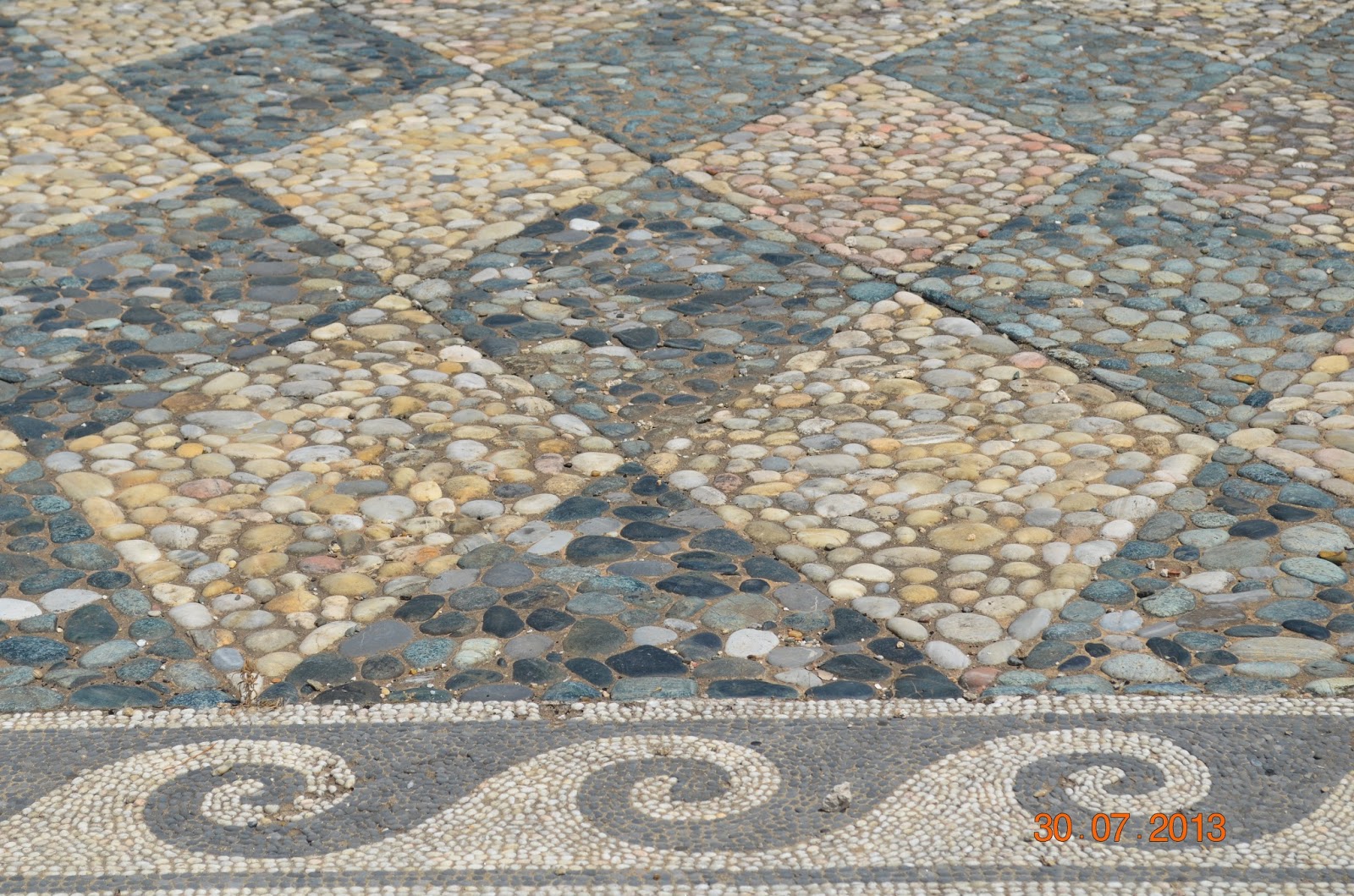
| A close up of the mosaic work; it amazes me to think that these tiny stones are intact having withstood time for centuries |
Subscribe to:
Posts (Atom)