Showing posts with label Europe. Show all posts

Tuesday, May 6, 2014

On The Ramparts Of Le Quesnoy


Yes, that is a vehicle bridge linking the town with the rest
of the world in the background
We are lucky to be living in a great location where so much of Europe is literally a stone's throw away. Such was the case on a recent weekend when we decided to visit the French town of Le Quesnoy, which we discovered is only a half hour away from our house. So yes, off we went to spend the morning in France. And what we found made this quick jaunt worth it and with its close proximity, I know it is a place we will be visiting again.

Le Quesnoy is located in northern France just over the Belgian border. Like so many of the other towns that dot the French and Belgian countrysides, Le Quesnoy has a long and storied history dating back to the Middle Ages. Over the years it has been defended, occupied, and / or abandoned by invading armies, most recently in 1940 when German forces were held at bay over the course of the four days during the Battle of France. This isn't what makes this little town with a population hovering around 5,000 so special. It is the great walls, or ramparts, surrounding the town that are bringing tourists and locals alike into this berg. That is, after all, what brought us there.

A wee stream flowing through the marsh
Two sets of five kilometer long brick ramparts circle the town creating a haven of green where mother nature and mankind meet. Truly. The area between the ramparts, what had been a part of the original "killing field" defense system of the town are now a nature preserve filled with streams, trees and flowers, and ducks. Lots and lots of ducks and other water fowl. A walking trail, dotted with strategically placed benches for sitting, alternated between the top of the ramparts and below, in between the brick walls. It meandered through the area creating a serene space that felt a world away from the hustle and bustle of the outside world. The outer brick walls which had been rebuilt and refortified over time created a barrier between the preserve and everything else.

We visited on a cool and damp morning and essentially had the preserve to ourselves. I'm not exactly sure what we were expecting to find but my first impression was that the area was green. Very green and lush. Everything from the grass and trees to the flowers and vines clinging to the brick walls was green. If felt as though spring was definitely alive. And best of all, because this area is truly a pedestrian only zone, Sidney was free to run, play, and explore to his heart's content. (This is especially important since we live in a city with only the most minuscule of green space available to him). We watched ducks swimming in the stream, stumbled upon an entire field of bunny rabbits frolicking in the damp grass, and climbed up and down too many sets of stairs to count. We explored tunnels, introduced Sidney to the wonders of buttercups (one of my favorite childhood memories), and just had a wonderful and relaxing stroll. And Sidney being Sidney, he threw his share of rocks into the water and found "the biggest stick ever". (His words, not mine).

Le Quesnoy is a true gem and I am so glad we found it. It is truly a beautiful place. But since pictures say it best, here are a few of my favorites:


Lush grass, bricks, and stones

The only thing stirring was this Mallard

I have no idea why I am so fascinated by these trees, but I am


Friday, March 7, 2014

Getting To Know Belgium: A Primer

So where is this tiny European country I now call home? And what is Belgium known for? I had these questions and many more when Glenn first told me that moving to Belgium was a possibility. Like any good student I immediately set out to learn more about where we would be spending the next three years and at first glance, I really liked what I saw. In fact, much of what I found was downright exciting. And then we arrived here and I realized that I had just scratched the surface of this great western European country perched on the edge of the North Sea.

Sandwiched between the Netherlands, France, Germany, and  even tinier Luxembourg, Belgium is a convenient jumping off point for exploring much of western Europe. If this isn't enough to keep you busy, a quick ferry or Chunnel ride across the English Channel will put all of Great Britain at your doorstep. But there is so much packed into this country of just over 30,500 square kilometers and a population of just under 10,424,000 that you don't have to leave to have a good time. Belgium is filled with chateaus, green space, historic centers, and yes, chocolate and beer. The capital of Brussels is perhaps best known for being the home of NATO making it an important player in global politics but this strategically located country has been a player on the world scene for much longer. Wars have been fought on what is now Belgian soil since the Middle Ages, the country was the site of the famous 1815 Battle of Waterloo and it was occupied by Germany during both World Wars. Today the struggle for national identity continues with an ongoing debate over a division of the country along Flemish and French lines.

Now here are a few more fact about Belgium:

  • Belgium is officially a tri-language country with residents of the northern (Flanders) region speaking a dialect of Dutch, those in the southern (Wallonia) region speaking French and a tiny population along the border with Germany speaking German. 
  • According to the World Health Organization and the CIA Fact Book, Belgians spend 51.84% less money on health care than their American counterparts while having a lower chance of dying in infancy (28.66%) and a longer life expectancy (1.13 years).  
  • On average, Belgians make 21.12% less money a year ($36,600 compared to $46,400) but also work fewer hours (1469 versus 1797) than Americans.
  • Gay marriage has been legal here since 2003 and euthanasia since 2002.
  • Voting is compulsory as is education up to the age of 18.
  • The Belgian road system is the only man made structure visible from the moon at night due to lights along the entire motorway network.
  • Over 800 kinds of beer are brewed in Belgium and the average Belgian consumes 150 liters of this local beverage a year.
  • Belgium produces 220,000 tons of chocolate a year which is equivalent to 22 kilograms of chocolate for every Belgian.
  • Belgium is home to 20 UNESCO World Heritage and Intangible Cultural Heritage sites.

We've only just arrived and there is so much of this country for us to explore and get to know. I can only hope we can see it all over the next three years.

Friday, February 7, 2014

Dorothy, We're Not In Kansas Any More

Or in our case the Mediterranean, specifically Albania-the land where anything and everything goes. We are in Belgium, attached to an international military command where rules and regulations are enforced. In many respects returning to a military community is like coming home for us but it isn't until you find yourself back in such an environment that you realize just how loosey-goosey things were where you came from. (And this isn't bad, I rather like it. But because it is different, it is simply an adjustment).

And the differences between the way things were and the way things currently are, are everywhere--at least to us. To begin with, lets talk weather. The Mediterranean climate which we had grown accustomed to was hot, sunny, and dusty in the summer and temperate, damp, and muddy in the winter. Here in Belgium the weather is essentially the same all year around- cool, cloudy, and rainy. But all of the rain serves a purpose. Even in February, Belgium appears green and lush. Acre upon acre of rolling green fields give way to even more greenery. No brown or arid fields here; everything looks fresh and healthy. And speaking of fields, this region of Belgium is flat without the steep mountains that cover much of Albania. When we are out driving around Sidney has been looking out the window and asking where all the mountains are. My response has been south of us........

But the biggest differences between our old world and new one are cultural.  First there are the families and children. Children are everywhere but rather than being treated like little kings and queens, they are expected to be seen and not heard. In some respects this attitude has been stressful for me; Sidney's occasional public temper tantrums which were met with sympathetic smiles and nods of understanding in Albania are greeted with sneers of disdain here. I have yet to see a child in public throwing a fit and even Sidney has noticed and commented on this. As he says, the babies (what he calls any child) are quiet. I'm using his observations as a lesson on how he should behalf and I dare say he is catching on. On more than one occasion when he would have otherwise protested loudly, he has quickly commented that he wants to be quiet like the other children. This is definitely not a bad thing.

And the differences go on. Smoking bans are actually enforced meaning restaurants, shops, and other public spaces are free of the plumes of smoke that I have sadly grown accustomed to breathing. Because of this, going out is actually a pleasant experience. Restaurant menus are varied rather than the same handful of items we are accustomed to seeing. That said, Sidney's standbys of pasta or pizza aren't always readily available. Sometimes this is a challenge but it is forcing a set in his ways little boy to expand his horizons. Whereas days in the Med started late and ended even later, here the schedules start and stop earlier than we have grown accustomed to. Finding a sit down restaurant that actually served food before seven in the evening was a challenge in Albania. In our little corner of Belgium, meal time begins earlier. But we're actually finding this to be a good thing. Eating dinner earlier may mean less down time between work and dinner but it translates into earlier bedtimes and yes, more sleep; sleep which is desperately needed by our entire family. Whereas in Albania we were just getting going by the time nine o'clock rolled around, since we've arrived in Belgium, we have all been fast asleep by this early witching hour. And these differences are just the tip of the iceberg.

But I believe that change and differences are good. It may not always be comfortable but in the end we are better because of them. And if there is one thing I've learned in the course of all my travels it is that what makes each country or region unique is what makes that place special. Just imagine how boring the world be if things were the same regardless of where we were on the globe. So we may not be in our Kansas anymore anymore but that doesn't make it better or worse than where we are now. It is just different and like I said, different is a good thing.

Tuesday, February 4, 2014

(Consumer) Culture Shock

I remember the first time I stepped foot in an Albanian grocery store. Looking around me I felt overwhelmed and out of my element as I didn't recognize any of the items I saw. At first glance the shelves were filled with a variety of items with foreign labels written in Italian, Greek, and sometimes Albanian. Items were not organized the same way they were in American stores leaving me wandering aimlessly through the aisles unable to find what I was looking for. At first I wasn't sure whether the item was simply unavailable in Albania, I was searching in the wrong place, or I was looking right at it and not recognizing it. After awhile, by looking closely at items, thanks to pictures, I was eventually able to figure out what was inside of most cans and jars but I still erred every once in awhile. I remember thinking I was buying capers and once they were added to my chicken piccata discovering that they were actually green peppercorns. Oops! Over time, however, my comfort level at Albanian shopping grew to the point where I knew what was located where and what was available, meaning on a good day I could be in and out of the store in a matter of minutes.  I learned to love the products that were available and became incredibly innovative in making substitutions when needed. And then we moved...............

I'll admit, here in Belgium, I'm once again feeling a bit overwhelmed about stepping foot in a grocery store. After living in a second world country, the choices available to me are stymieing me from the moment I grab my shopping carriage. Because we are now located in close proximity to an American military base, I now have regular access to commissaries. For the unfamiliar, commissaries are essentially military grocery stores that sell American grocery products. Regardless of where you are in the world, whether you are in Virginia, San Diego, Japan or yes, Belgium, the store layouts are the same and you can buy your Oscar Meyer Bacon, Old El Paso Taco shells and Bounty paper towels. (It is like having a little piece of America in your shopping cart). Stepping into the commissary for the first  time I felt like I was immediately transported back to  northernVirginia. But I was overwhelmed just the same. I was simply not used to having so many options.

By the time we left Albania many of the most popular American brands were available in the stores. Heinz ketchup lined the shelves and it even came in a "spicy" version which wasn't all that spicy. Coke was always available but the European version was made with sugar rather than corn syrup, which produced a drink with a totally different flavor. Pringles were readily available in every store in Albania but the flavors were different and limited. Sidney's favorite in Albania were called "spicy" which in reality was a red pepper flavor. Here the choices are endless; while not including red pepper you can even buy pecan pie and guacamole or one of many other varieties. Who knew?  Looking for an easy dinner option, I selected boxed pasta and Barilla sauce from the shelf. First, the number of brands available to me was overwhelming. While the pasta tasted the same as the Albanian version, the sauce, one that I regularly bought in Albania, was different. Despite being the same brand, what was in my jar was sweeter and thicker than what I had bought in Albania. Looking closely at the label I saw that my Italian Barilla pasta sauce had been imported from the United States. I suddenly found myself longing for my European sauce. And rice for risotto, my go-to meal? None could be found on the shelves but I could have bought ten different varieties of instant or quick cooking white rice. But some of the differences in products were wonderful. My name brand paper towels purchased from the commissary were soft and absorbent rather than the flimsy yet stiff paper products I had grown accustomed to. My hands actually felt soft rather than shriveled and dry after washing a sink full of dishes with my American dish detergent. These are a few of the "luxuries" I had been missing.


But my options don't end there. In addition to the American commissary, there is a whole variety of European grocery stores in Belgium. The most prevalent appears to be Carrefour, a French grocery chain that also established a small footprint in Albania during our final year there. But all Carrefour stores are not created equal. I know stores cater to their market and in that respect I suppose that the Albanian Carrefour stores meet the needs of their clientele. In fact, the items they carried were not all that different from those sold in the other grocery store chain in Albania. Choices were limited but somehow it seemed to work. But Belgian Carrefour stores? They are a whole other beast that are
overwhelming in their own (good) way. Looking for cheese? Forget one aisle, there are several. Do you want crackers to accompany your cheese? There is an entire aisle of different varieties dedicated to just this. In Albania you might find an entire aisle of crackers but they were all the same saltine-style cracker. Juice? With the exception of the red orange juice that Sidney loves, this Carrefour has every variety imaginable. And yes, there are American brands as well. In addition to European brands, the cereal aisle is filled with Kellogg's varieties that again, I never knew existed. Need to fulfill your Mexican cravings? You have choices here too. And the options just go on and on.

Honestly, at the moment I feel as though I have too many choices. While I still love certain American products, I've grown used to shopping in local markets and for the most part, buying European products. (For all you bakers out there, those gourmet European butters that cost an arm and a leg in America are everyday inexpensive here!). Even in the midst of my cultural shocked daze, I'm realizing that I now have the best of both worlds. I can buy the American products I love (cleaning and paper products) and the European brands I've grown to prefer all while discovering items unique to Belgium. Once I recover from my initial shock, this is going to be fun. And if history holds true, I'll soon be in and out of these stores in a matter of minutes as well.........or maybe not since I do have a lot of options.


Thursday, November 21, 2013

Windows Into History

Crosses outside of an
Orthodox church in
Bucharest, Romania
Wednesday's post was a pictorial of some of the European churches we have visited.  It was only while looking at my pictures from the past two years that I realized just how many churches we have visited.  I've lost track of the exact number we've toured but I feel confident in saying that we've toured at least one, and likely more, in each city and country we've traveled to.  Its almost ironic that visiting churches has become the highlight of so many of our travels.  Despite Glenn's being a graduate of Catholic school and my being a religion minor in college, neither one of us is what you could consider religious and unless we are visiting family, we do not attend church services.  But drop us into a foreign city and we are quick to visit the local cathedral, lesser known churches, and mosques as well. Even Sidney knows the routine and removes his hat and speaks in a whisper when we approach any church.  Perhaps it is because of our secular view on life that we can really appreciate these centers of religious life for their sheer beauty, architectural magnificence and historical significance.  Whether the churches are Muslim mosques, Roman Catholic cathedrals, or Orthodox Christian monasteries, each one is unique in its own way and provides visitors with a brief peak into a community's heritage and silently speaks to the rich and diverse history of Europe.

There are are two things that I'm discovering with the more time I spend overseas. First, despite its (comparatively) small size, Europe is culturally diverse and as such, has a diverse religious heritage meaning churches are every where.  And I do mean every where.  In many cities it is possible to visit churches of differing faiths all within a block of one another.  The second thing I've come to realize is that Europe is old. I mean really old and not the "new" old of the United States.  Stepping foot into a church dating back many hundreds, if not thousands, of years is much more common than visiting one built during our lifetime.  And these churches speak directly to the times during which they were constructed.  Ornate or stark, gilded, stone or wooden, all are important houses of worship for their followers.


Paris' Notre Dame Cathedral was impressive but I liked the
neighboring Sainte Chapelle better
Prior to coming to Albania I had heard the call to prayer but never stepped foot inside of a mosque.  My first of many mosque visits was to the world famous Blue Mosque in Istanbul, Turkey and I was immediately struck by its grand size and ornate blue tiles.  Its opulence rivaled that of the grandest of gilded Catholic cathedrals.  Other smaller mosques in the city were almost but not quite as grand as well.  The Catholic churches of western Europe are some of the most ornate and lavishly decorated buildings I have ever encountered.  In many of them, even the "lesser" churches everything appears to be gilded in gold.  I expected as much when visiting the Vatican and St. Peter's Basilica, but had expectations of seeing fewer jewels and gold in other churches.  I quickly found that this wasn't necessarily the case.  It continues to boggle my mind when I think about the sheer net worth of these churches where the walls and ceilings alone probably cost more than the annual budget of a small country.  At the same time, I've learned that these cathedrals weren't built overnight, often taking centuries to complete.  From a historical perspective, it is easy to understand that during the darker periods in history, where religion played such a large role in everyday life, even the most common  of people would give their money to "the Church" with the hope of achieving happiness and enlightenment in their after life.  But then again, not all Catholic churches are gilded in gold.  Traveling through the countries encompassing the former Austro-Hungarian empires, many of the churches are sparsely decorated stone sanctuaries where the sound of a pin dropping would be sure to echo.  Again, this speaks to the times
Inside St. Mary's Basilica in Krakow, Poland
and places where these churches were built.  
Many of the Orthodox churches I've visited have tended to be dark and solemn, smelling heavily of incense. This was particularly the case during our travels through Romania and Bulgaria where the churches we visited may have had ornate carvings and frescoes that rivaled those found in Catholic churches but were much darker and more somber than the gold gilded insides of their Catholic contemporaries.  From the narrow seats that serve as pews to the somber faced icons on the walls, these churches leave me with the feeling that life, and the church itself, is a punishment and mental, if not physical, torture.  But their darkness has its own form of beauty and to me at least, speaks volumes about the history and times of the church.  
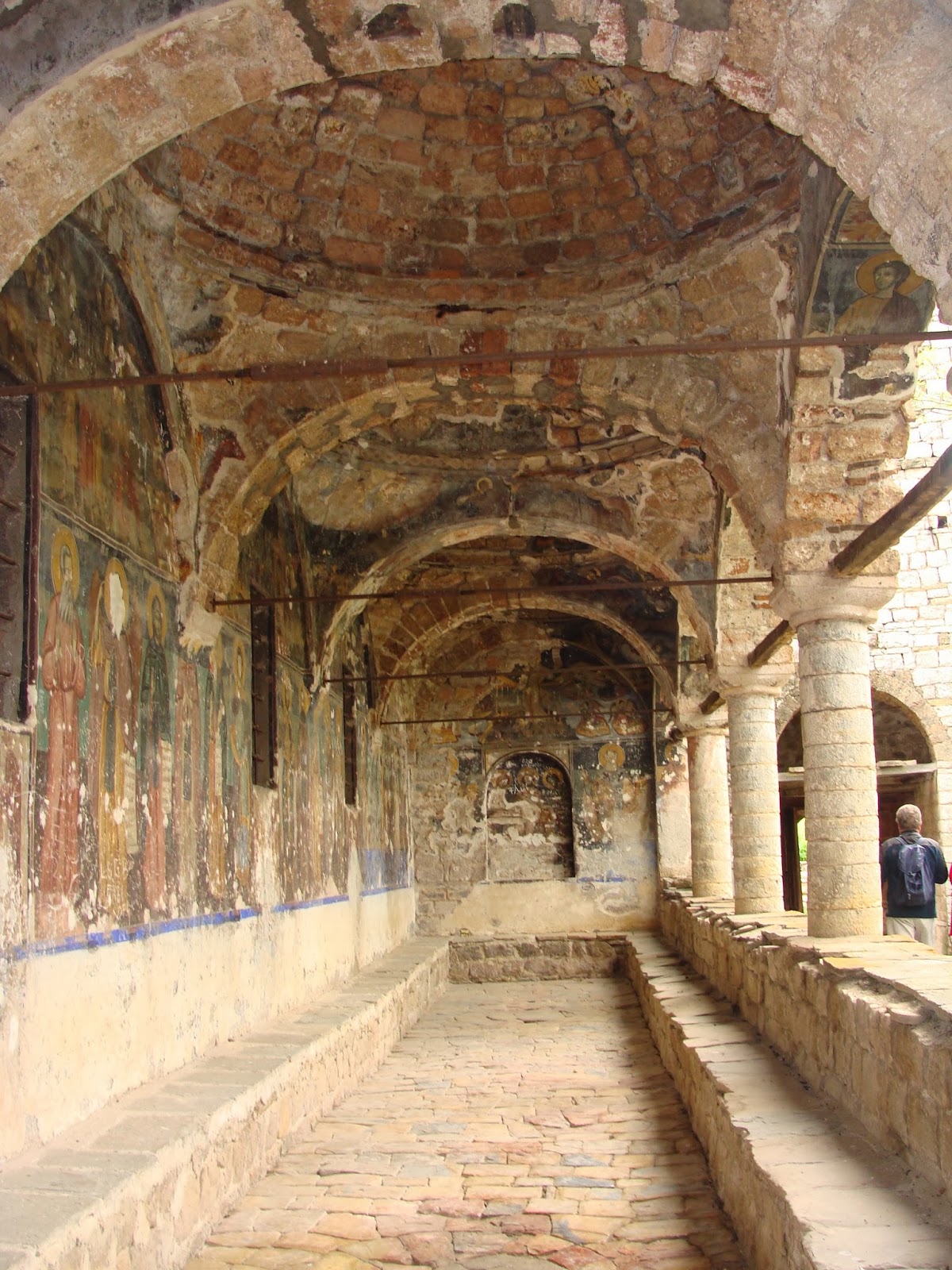
Frescoes in Voskopoja

And then you have Albanian churches.  During the Communist era, all forms of religion were outlawed and Albania was officially designated as a secular state.  Many, but not all, of the churches and religious icons were destroyed and religion of any kind was not practiced publicly.  (Fortunately, some of the more historically valuable icons were spared destruction and are now housed in a museum in the city of Korce).  Today, Albania is a religiously tolerant country that on paper is predominently Muslim but it has its share of Catholic and Orthodox churches as well.  Old churches and monasteries exist in various states of (dis)repair but for the most part they lack the ornate trappings found in so many other churches.  In some churches you can see remnants of frescoes and other religious icons but in others you encounter nothing but barren stone walls.  The hilltop town of Voskopoja, once a thriving commercial hub in the Balkans but now a small village with numerous churches in various conditions, is undergoing a renaissance of sorts where her ancient churches are being painstakingly restored.  Many of them exist as piles of rubble or nothing but shells of their former selves.  New religious buildings of all faiths are being erected throughout Albania as well.  These contemporary structures may lack the grandness of older churches, but regardless of the trappings, they serve their religious purpose.  I've learned that visiting an Albanian church, regardless of its denomination, is a solemn affair but then again, this speaks directly to the history and culture of the country. 

But the message I get from visiting an Albanian church is no different than visiting one in nearby Greece or Macedonia or France or Sweden.  The religious beliefs practiced inside the walls may differ and some may be more ornate than others but all are symbolic of their people and the times in which they were built.  For me, walking into any church is like stepping back into history.   And houses of worship are an vital part of Europe's long and storied history.